Tea Brands Ranked by Microplastics: Which Tea Bags Are Plastic-Free? (2026)

Last reviewed: by the MicroPlastics Research Desk. Submit a correction or see our editorial standards.
Quick Answer
Got a different brand in the cupboard? Scan the label for its polymer, risk score, and a cleaner swap.
Scan my product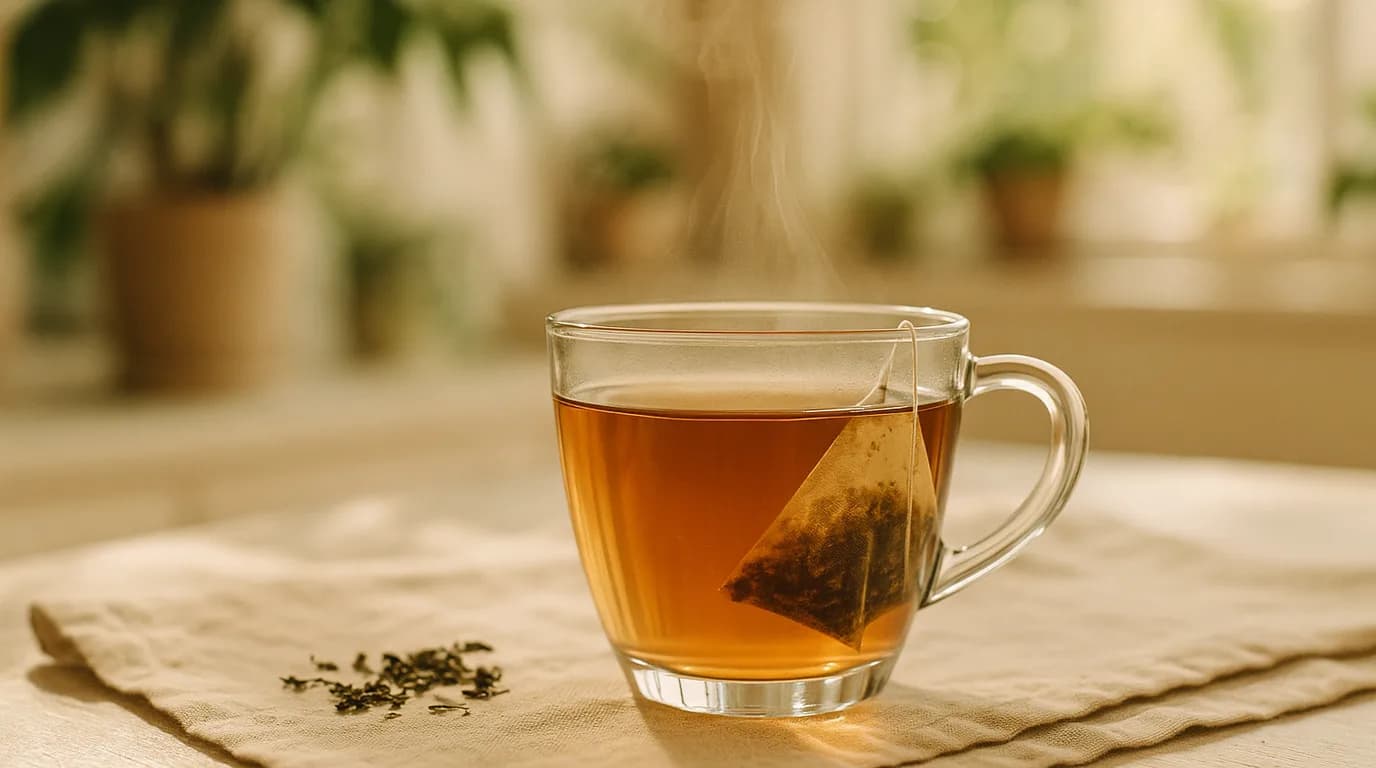
Key Takeaways
- Nylon and PET “silken” pyramid bags are the single highest-release food item measured in the literature: about 11.6 billion microplastic particles per cup at 95°C.
- You can identify the risk by touch and sight. Mesh, sheer, triangular and stretchy means plastic. Opaque, papery and flat usually does not.
- Paper bags are far better but typically contain a few percent polypropylene in the heat-seal, so they are low rather than zero.
- “Plant-based” and PLA bags still shed particles. Bio-derived is a compostability claim, not a no-particle claim.
- Loose leaf plus a stainless or glass infuser removes the bag from the equation entirely and is usually cheaper per cup.
The study that made this a real question
In 2019, researchers at McGill University published work in Environmental Science & Technology that has shaped every subsequent conversation about tea. They took commercially available pyramid-style tea bags made from nylon and polyethylene terephthalate (PET), removed the tea itself so they were measuring only the bag, and steeped the empty bags in water at 95°C, ordinary brewing temperature.
A single bag released approximately 11.6 billion microplastic particles and 3.1 billion nanoplastic particles into that one cup. For scale, published estimates of total human microplastic intake from all other dietary sources combined were, at the time, several orders of magnitude lower. One cup of tea brewed in a plastic mesh bag was plausibly a larger single exposure than everything else a person ate that day.
Two things are worth being precise about, because this study is often overstated. First, the particle counts are extremely high in number but very small in total mass, because nanoparticles are tiny. Second, the health significance of that exposure is still genuinely unresolved, the study measured release, not harm. What it establishes beyond argument is that hot water plus a plastic mesh bag is a highly efficient way to get plastic particles into a drink, and that this is easily avoidable.
How to tell what your tea bag is made of
You do not need the packaging to work this out. The two families look and feel completely different:
- Plastic mesh (avoid). Sheer enough to see the leaves through, faintly shiny, smooth and slightly stretchy, holds a crisp pyramid or tetrahedron shape. Marketed as “silken”, “silky”, “mesh”, “pyramid”, “temple” or “sachet”. Almost always nylon or PET.
- Paper (fine). Opaque, matte, fibrous, goes limp when wet, usually a flat rectangle or a simple round. Sometimes stapled, sometimes folded, sometimes heat-sealed.
- The paper caveat. Most heat-sealed paper bags contain roughly a few percent polypropylene woven or sprayed in, because pure cellulose will not fuse to itself. Stapled and folded-and-stringed bags avoid this. So paper is low, not zero.
Tea brands ranked by bag material
No tea company publishes microplastic testing on its own bags, so this table ranks what the bag is made of, which is the thing the research actually connects to release. Brands change materials, and many run several formats at once, so the format on the box you are holding matters more than the brand name.
| Brand | Typical bag material | Plastic contact | Note |
|---|---|---|---|
| Loose leaf + steel infuser | None | None | The only true zero. Usually cheapest per cup too |
| Yogi | Unbleached paper, string, no staple | Very low | Folded and stringed, so no heat-seal polypropylene |
| Celestial Seasonings | Paper, no staples | Very low | Long-standing staple-free paper construction |
| Pukka | Paper with organic cotton string | Very low | Stitched rather than heat-sealed |
| Traditional Medicinals | Paper, stringed | Very low | Paper sachet overwrap on some lines |
| Bigelow | Paper (heat-sealed) | Low | Small polypropylene fraction in the seal |
| Twinings (standard boxes) | Paper (heat-sealed) | Low | But their pyramid range is mesh, check the box |
| PG Tips | Plant-based / PLA pyramid | Moderate | Compostable, still a polymer that sheds particles |
| Teapigs | PLA "temples" | Moderate | Same caveat: bio-based is not particle-free |
| Lipton (pyramid range) | PET mesh pyramid | High | Their flat paper bags are a much better pick |
| Harney & Sons (sachets) | Nylon mesh sachet | High | The classic "silken sachet" format |
| Any "silken" pyramid | Nylon or PET | Highest | This is the format the 2019 study measured |
The uncomfortable pattern here is that price and perceived quality run backwards to plastic exposure. The cheap supermarket box of flat paper bags is a better choice on this specific measure than the expensive mesh pyramid sachet, because the mesh pyramid was invented to look premium, and nylon holds that shape while paper does not.
Why “plant-based” bags are not the fix
Several brands have moved from nylon to PLA(polylactic acid), a polymer made from corn starch or sugarcane, and market it as plant-based, biodegradable or compostable. Those claims are about end of life, specifically that the bag will break down in an industrial composting facility.
They say nothing about what the bag does in your mug. PLA is still a plastic in the sense that matters here: it is a synthetic polymer mesh sitting in near-boiling water, and it sheds particles under those conditions. A compostable pyramid is a meaningful environmental improvement and a marginal personal-exposure one. If you are reading this for exposure reasons, PLA is a step down from nylon, not a solution, and paper or loose leaf is the actual answer.
What to do instead
- Best: loose leaf in stainless steel or glass. A basket infuser costs a few pounds once, opens up far better tea, and works out cheaper per cup than bags. This removes the entire question.
- Very good: stapled or stringed paper bags. No heat-seal means no polypropylene in the seal. Yogi, Celestial Seasonings and Pukka are easy to find.
- Fine: ordinary heat-sealed paper. A small polymer fraction in the seal, nothing like a mesh bag.
- Avoid: any mesh pyramid, whatever it is made of. If you can see the leaves through the bag and it holds a sharp shape, put it back.
- Don't squeeze or stir the bag. Agitation increases release from any bag material, and there is no brewing benefit that justifies it.
- Watch the mug too. A plastic travel lid or a melamine mug puts another hot-contact surface in the system. See microplastics by brewing method for the same logic applied to coffee.
What the MicroPlastics app checks
- Whether the tea you buy uses a paper bag, a nylon or PET mesh pyramid, or a PLA “plant-based” mesh.
- A 0–100 risk score that weighs bag material, brewing temperature, and packaging together.
- A lower-plastic swap in the same tea style, usually a paper-bagged or loose-leaf version of what you already drink.
- Your running hot-drinks profile, so a daily tea habit is scored as a habit rather than a single cup.
Use the App
Check your tea before the next box
Mesh pyramid or paper changes the answer by orders of magnitude, and the box rarely says which you are getting. Scan your tea with MicroPlastics for a 0–100 score and a lower-plastic version of the same blend.
Scan my teaRelated: microplastics in tea bags, microplastics in coffee by brewing method, do coffee filters have microplastics, and best plastic-free coffee makers.
Frequently Asked Questions
Which tea bags have the most microplastics?
Are paper tea bags completely plastic-free?
Do Twinings or Lipton tea bags contain plastic?
Are compostable or plant-based tea bags better?
Does squeezing the tea bag release more plastic?
Sources
- Hernandez LM, Xu EG, Larsson HCE, Tahara R, Maisuria VB, Tufenkji N (2019). Plastic teabags release billions of microparticles and nanoparticles into tea. Environmental Science & Technology.
- Ranjan VP, Joseph A, Goel S (2021). Microplastics and other harmful substances released from disposable paper cups into hot water. Journal of Hazardous Materials.
- Cox KD, Covernton GA, Davies HL, et al. (2019). Human consumption of microplastics. Environmental Science & Technology.
Audit your whole pantry, not just the 5 foods in this article
The app keeps a running scan history for every packaged food you own, every brand swap you make, and every reformulation a brand quietly pushes. The article is a snapshot. The app is the trend line.
Download on the App Store- Free on iOS
- 3 free scans
- No sign-up
- Result in seconds
“Really cool to scan stuff around the kitchen and see what's actually in it. The swaps it suggests are realistic.” App Store review · 5.0★
Android · early access
Get the launch email the day Android opens.
One email. No spam. We send when the Android app is in the Play Store, and never again unless you opt in.
Related Research
Can Food Help Clear Microplastics? Kimchi, Fiber & the Evidence (2026)
A kimchi bacterium (Leuconostoc mesenteroides CBA3656) bound 57% of nanoplastics and doubled plastic excretion in mice. What that means for your plate, what fiber does, and the honest limit: food may block absorption, not clear what's already stored.
Read moreDo Energy Drinks Have Microplastics? Prime, Celsius, Red Bull & Monster Ranked (2026)
No brand tests its drink, so packaging decides it. Canned energy drinks (Celsius, Red Bull, Monster) shift the question to the liner; Prime Hydration's plastic bottle is the real shedder. The honest 2026 ranking and the lowest-plastic pick.
Read moreDoes Sous Vide Cook Food in Plastic? Microplastics in Sous Vide, Explained (2026)
Yes, sous vide seals food in plastic for hours in warm water, so migration is a fair worry. But it runs below boiling and proper bags are food-grade polyethylene, the lowest-leaching plastic. The real mistakes, and the silicone/glass alternatives.
Read moreDoes Almond Milk Have Microplastics? Brands Ranked by Packaging (2026)
Almost certainly, like all packaged drinks, and the carton vs plastic jug decides how much. Almond Breeze, Silk, and Califia compared by packaging, plus the lowest-plastic way to drink it. No animal-fat baseline is one built-in advantage.
Read moreDoes Fairlife Have Microplastics? Protein Shakes Ranked (2026)
Almost certainly, like all bottled dairy. No Fairlife-specific count exists, but the plastic bottle, the ultrafiltration, and milk's own baseline all contribute. How Fairlife, Premier, OWYN, and Muscle Milk compare, and the lowest-plastic protein.
Read moreDo Nespresso Pods Have Microplastics? The Aluminum-Liner Answer (2026)
Yes, but far fewer than plastic K-Cups. Nespresso pods are aluminum with a thin food-grade polymer liner, the liner is the microplastic-contact layer. What the research shows, how Vertuo and Original differ, and the lowest-shed setup.
Read more