Non-Toxic Gift Guide 2026: Low-Plastic Picks by Category
Last reviewed: by the MicroPlastics Research Desk. Submit a correction or see our editorial standards.
Quick answer

Check a product we did not cover
Scan it to see its materials, the evidence behind its score, and a lower-plastic option.


Free · 3 scans · iOS and Android
Key Takeaways
- Pick daily-contact items. A water bottle or food container touches food and drink hundreds of times a year; a decorative gift does not.
- “Plastic-free” usually means plastic-light. Glass bottles have polypropylene caps and glass containers have plastic lids.
- Silicone is the common substitute. It is not plastic in the usual sense, but it is a synthetic polymer, so we name it.
- Wooden toys come down to the finish. Look for named water-based stains or plant oils and a stated toy-safety standard.
- A HEPA vacuum is the one gift aimed at dust, where indoor fibers and particles collect. It is plastic itself.
- Each category links to our full buying guide with more options and the evidence behind them.
Numbers worth knowing before you shop
- plastic particles per liter in bottled water, on average
- ~240,000
- about 90% nanoplastics; 2024 imaging study of bottled water, not of any product here
- Qian et al., PNAS 2024
- of 0.3 µm particles captured by a true HEPA filter
- 99.97%
- theoretical minimum at the hardest size to catch
- US EPA
- plastic gaskets in a stainless ECOlunchbox Three-in-One
- 0
- maker says it is not leak-proof for that reason
- ECOlunchbox
- wool or cotton in Faribault Mill blankets
- 100%
- per the mill’s FAQ; baby blankets are wool and cotton
- Faribault Mill
How we chose these gifts
Every product here meets three rules. The maker publishes the materials on its own site, and we opened that page on November 8, 2026. The material that touches food, drink, skin or a child’s mouth is glass, steel, cast iron, wood, wool or cotton. And we can name what is still plastic. We left out products whose makers would not say what a part is made of, and we did not test anything ourselves. Prices change, so we have left them out.
One honest caveat applies to the whole list. Cutting plastic contact is a reasonable precaution, but research has not shown that switching any single product changes someone’s health. Our health evidence review lays out what is and is not known.
The gift list at a glance: what touches food or skin, and what is still plastic
- Gift
- Water bottle
- Example (maker page opened)
- Lifefactory 16 oz Classic Cap
- Contact material
- Glass (soda lime)
- Still plastic or polymer
- Polypropylene cap; silicone sleeve
- Full guide
- Glass water bottles
- Gift
- Coffee brewer
- Example (maker page opened)
- Chemex Classic
- Contact material
- Borosilicate glass, paper filter
- Still plastic or polymer
- None listed
- Full guide
- Plastic-free coffee makers
- Gift
- Cookware
- Example (maker page opened)
- Lodge cast iron
- Contact material
- Cast iron, soy-oil seasoning
- Still plastic or polymer
- None in the pan
- Full guide
- Non-toxic cookware
- Gift
- Blanket
- Example (maker page opened)
- Faribault Mill wool or cotton
- Contact material
- 100% wool or 100% cotton
- Still plastic or polymer
- Packaging, labels
- Full guide
- Polyester and clothing guides
- Gift
- Wooden toys
- Example (maker page opened)
- Grimm’s Pastel Mosaic; PlanToys
- Contact material
- Lime wood or rubberwood, water-based finishes
- Still plastic or polymer
- Varies by toy; check wheels, cords, parts
- Full guide
- Plastic toys guide
- Gift
- Food storage
- Example (maker page opened)
- Pyrex Freshlock; ECOlunchbox
- Contact material
- Glass; stainless steel
- Still plastic or polymer
- Pyrex lids are plastic; ECOlunchbox none
- Full guide
- Plastic-free food storage
- Gift
- Kids’ bottle
- Example (maker page opened)
- Pura Kiki 11 oz straw bottle
- Contact material
- 18/8 stainless, silicone straw
- Still plastic or polymer
- Silicone lid, straw and sleeve (maker says zero plastic)
- Full guide
- Kids’ water bottles
- Gift
- Vacuum
- Example (maker page opened)
- Miele with HEPA AirClean filter
- Contact material
- Not a contact item
- Still plastic or polymer
- Body, bags and filter housing
- Full guide
- Microplastics in the air at home
Glass and steel water bottles
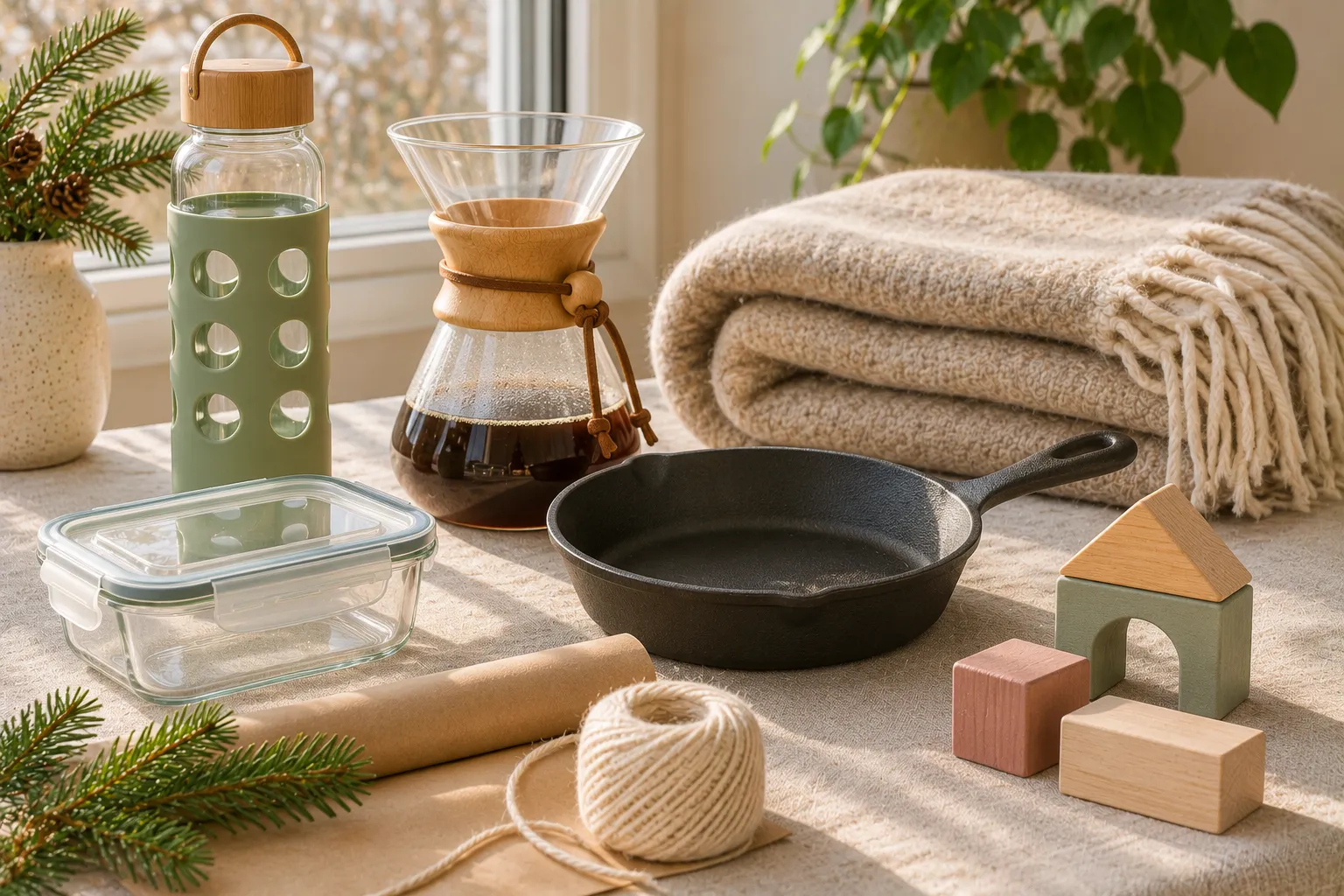
A bottle is the easiest high-use swap. The Lifefactory 16 oz Classic Cap is a glass bottle with a protective silicone sleeve and a polypropylene screw cap. The maker lists the glass as made in France, the cap in Poland and the sleeve in the US, and says it is dishwasher safe with the cap on the top rack. Its FAQ notes the hydration bottles are soda lime glass, so they are not for boiling water. What is still plastic: the cap, which touches the rim and the water when you tip the bottle.
For a recipient who drops things, stainless steel is the alternative. Our glass water bottle guide compares glass options and caps, and borosilicate vs soda lime explains the glass difference. Put the bottle in context: plastic bottled water is where the large particle counts come from, with about 240,000 per liter on average in one 2024 study.
Plastic-free coffee gear
Many coffee makers route hot water through plastic tanks, tubes and baskets. A pour-over brewer avoids all of that. The Chemex Classic is lab-grade borosilicate glass with a rubber wood collar and wooden bead tied on with a full-grain leather tie. Chemex lists no plastic parts for the Classic series. Remove the collar and tie before putting the glass in the dishwasher, and do not reheat coffee in it in the microwave. What is still plastic: nothing in the brewer itself. Chemex describes its bonded filters as biodegradable and compostable.
Pair it with a stovetop or plastic-light kettle if the recipient’s current one is plastic; see microplastics in electric kettles. Our plastic-free coffee maker guide covers automatic brewers too, part by part.
Cast iron and stainless steel cookware
Scratched nonstick coatings can shed coating fragments, which is why cookware is a common upgrade gift. Cast iron has no synthetic coating to wear off. Lodge says it seasons its cookware at the foundry by spraying a thin layer of Kosher-certified, soy-based vegetable oil and baking it. A 10- or 12-inch skillet is the most useful single piece. What is still plastic: nothing in the pan, though some handle covers are silicone.
Cast iron is heavy and needs drying and occasional oiling, so for someone who wants dishwasher-friendly pans, tri-ply stainless steel is the other uncoated choice. Add a solid wooden spatula; our spatula guide matches tools to pans, and the non-toxic cookware guide ranks the pans themselves.
Wool and cotton textiles
Fleece throws and microfiber blankets are polyester, and synthetic textiles shed fibers into household air and laundry water. A natural-fiber blanket is a gift that gets used every night. Faribault Mill lists its wool blankets as 100% wool, its cotton blankets as 100% cotton and its baby blankets as wool and cotton, made at its mill in Faribault, Minnesota. It recommends minimal care for wool: spot-treat, shake and air it out, and check the label before washing. What is still plastic: packaging and labels. The mill’s FAQ does not mention moth-proofing treatments, so ask if that matters.
Read the fiber line on any blanket or throw: “wool blend” often means acrylic or polyester. Our polyester guide and clothing guide explain fiber shedding.
Wooden toys: check the finish
Wood replaces plastic in the mouth of a baby or toddler, but the finish is what touches the child. Grimm’s Pastel Mosaic, a set of 36 blocks in a frame, is lime wood with a non-toxic water-based color stain and a plant-based oil finish, and the maker lists it as approved for ages 1 and up. PlanToys says it uses preservative-free rubberwood, certified E-Zero formaldehyde-free glue, and organic color pigments with water-based dyes, and that its toys meet European (EN71) and American (ASTM) toy-safety requirements.
What is still plastic varies by toy. Push toys and vehicles may have rubber or plastic wheels, and pull toys may have synthetic cord, so read the individual product page. Skip glossy painted wooden toys from sellers that do not name the paint or a safety standard. Our plastic toys guide explains what children’s toy rules cover.
Use the App
Checking a gift before you buy it?
Scan a bottle, container, toy or pan, or the listing for one. The app records declared materials, flags the lid, gasket or finish that is still plastic, and saves the item to a gift list you can share.
Glass and steel food storage
Containers are the gift that changes the most daily contact, especially for anyone who reheats leftovers. The Pyrex Freshlock 10-piece set pairs glass containers with locking lids. Pyrex says the containers and its BPA-free lids are dishwasher, freezer and microwave safe; it does not name the lid plastic. What is still plastic: the lids. Our advice is to reheat in the glass with the lid off or replaced by a plate, which keeps hot food off the plastic.
For lunches, the ECOlunchbox Three-in-One is three nesting containers made of food-grade stainless steel. The maker says it is not leak-proof because it uses no plastic gaskets, and that it is not for the microwave. What is still plastic: nothing in the box. Our plastic-free food storage guide compares lids and seals across brands, and school lunchboxes covers kids’ versions.
A HEPA vacuum
House dust is where indoor microplastic fibers settle, and a vacuum that leaks fine dust out of its exhaust puts some back in the air. A true HEPA filter captures at least 99.97% of particles at 0.3 µm, the hardest size to catch, according to the EPA. Miele rates its HEPA AirClean filter as HEPA class 13 under the European filter standard and claims 99.99% filtration performance when its vacuums are fitted with the AirClean filter system, tested under the IEC 62885-2 standard. What is still plastic: the vacuum body, the filter housing and disposable bags. This gift does not reduce plastic; it reduces what you breathe after cleaning. See microplastics in the air at home for the rest of the dust picture.
Gifts for kids and babies
Children’s bottles chew through straws and spouts, so material matters. The Pura Kiki 11 oz Kiddo Straw Bottle is an 18/8 stainless steel bottle with a lid, straw and sleeve made of silicone; Pura calls it 100% plastic-free, says the straw is platinum-cured silicone, and says it is MadeSafe certified. What is still a polymer: the silicone. It is not a conventional plastic, but it is not inert either, and the straw is the part a child chews. Replace it when it tears. Our kids’ water bottle guide compares brands.
Wooden toys from the section above, a wool or cotton baby blanket, and a stainless lunchbox round out a child’s list. For bottles for infants, see baby bottles.
Which gift fits which person?
The best swap is the one that replaces something the recipient already uses a lot. A beautiful glass carafe does little for someone who drinks tea from a plastic electric kettle all day. Start from their habits.
| If they… | Give | Plastic contact it replaces |
|---|---|---|
| Carry a plastic bottle everywhere | Glass bottle with sleeve, or stainless steel | Daily drink contact with the bottle wall |
| Run a pod or drip machine | Glass pour-over brewer and paper filters | Hot water through plastic tanks, tubes and baskets |
| Cook on a worn nonstick pan | Cast iron skillet plus a wooden spatula | Scratched coating and plastic utensils at high heat |
| Meal-prep in plastic tubs | Glass storage set; reheat with the lid off | Hot food against plastic in the microwave |
| Pack school lunches | Stainless lunchbox and a stainless kids’ bottle | Daily contact for a child, plus chewed spouts |
| Have a new baby | Wool or cotton blanket, wooden toys with named finishes | Fleece against skin, plastic toys in the mouth |
| Live with carpets, pets or allergies | Sealed HEPA vacuum | Not contact: fine dust blown back out during cleaning |
How to read a “plastic-free” label
Gift listings use the phrase loosely, so check three things before you trust it. First, find the parts list. A bottle or container is several parts, and the claim often describes only the body. If the page names the cap, lid, gasket and straw materials separately, that is a good sign; if it says “BPA-free” and nothing else, the part is plastic. Second, see how the maker treats silicone. Pura calls its silicone-lidded bottle 100% plastic-free, which is a defensible reading of the word, but a buyer who wants no synthetic polymer at all would disagree. Third, look for what touches the food or skin during use, not in the product photo. A glass container with a plastic lid used cold in the fridge is a different exposure from the same lid steaming in the microwave.
Certifications help with chemistry, not particles. Toy standards like EN71 and ASTM cover things like heavy metals in paints and small parts; MadeSafe screens ingredients. None of them measures microplastic release, and no gift on this list has that test either.
What to skip, and how to wrap
- “Eco” bamboo dinnerware that feels like plastic. Molded bamboo-fiber products often contain melamine resin. See our bamboo-melamine guide.
- Fleece and microfiber throws labeled “cozy” or “plush” are polyester.
- Gift sets with black plastic utensils of unknown origin.
- Glitter and foil wrap. Conventional glitter is usually plastic film. Brown paper, fabric wraps and paper tape are easy swaps.
- Pre-lit decorations as gifts if the recipient has toddlers; PVC cords have tested positive for lead. Our artificial tree guide explains.
What the evidence does not establish
- A particle test for any named product. We found none for the items on this list.
- That glass or steel means zero particles in a drink. Water and coffee carry what they started with.
- That silicone is the same as plastic, or totally inert. It is a different polymer that can release siloxanes in migration tests.
- A health benefit from any one gift. These are precautionary swaps.
What the MicroPlastics app checks
- The declared materials of a scanned bottle, container, pan, toy or textile, part by part.
- Which parts are still plastic or silicone, such as caps, lids, gaskets, straws and finishes.
- Lower-plastic alternatives in the same category, saved to a list.
- Product information only: the app does not measure particles shed by any product.
Frequently Asked Questions
What are good non-toxic gifts?
Are glass water bottles plastic-free?
Is silicone plastic-free?
Are wooden toys safe for babies?
Does a HEPA vacuum remove microplastics?
Do these products have microplastic test results?
Sources
- Lifefactory (2026). 16 oz Glass Bottle with Classic Cap and Silicone Sleeve: polypropylene cap, silicone sleeve, origin by part (retrieved November 8, 2026). lifefactory.com.
- Lifefactory (2026). FAQ: soda lime hydration bottles, borosilicate baby bottles (retrieved November 8, 2026). lifefactory.com.
- Chemex (2026). Classic Series product support: borosilicate glass, rubber wood collar, leather tie (retrieved November 8, 2026). chemexcoffeemaker.com.
- Lodge Cast Iron (2026). Oils for cast iron cooking and seasoning (retrieved November 8, 2026). lodgecastiron.com.
- Faribault Mill (2026). FAQ: fiber content, care, made in Faribault, Minnesota (retrieved November 8, 2026). faribaultmill.com.
- Grimm’s (2026). Pastel Mosaic: lime wood, water-based stain, plant-based oil finish (retrieved November 8, 2026). grimms.eu.
- PlanToys (2026). FAQ: rubberwood, E-Zero formaldehyde-free glue, water-based dyes, EN71 and ASTM (retrieved November 8, 2026). plantoys.com.
- Pyrex (2026). Freshlock 10-piece glass storage set (retrieved November 8, 2026). pyrexhome.com.
- ECOlunchbox (2026). Three-in-One Classic: food-grade stainless steel, no plastic gaskets (retrieved November 8, 2026). ecolunchboxes.com.
- Pura Stainless (2026). Kiki 11 oz Kiddo Straw Bottle: 18/8 stainless, silicone lid and straw (retrieved November 8, 2026). purastainless.com.
- Miele USA (2026). HyClean Air pack with HEPA AirClean filter: 99.99% per IEC 62885-2; HEPA class 13 per DIN EN 1822 (retrieved November 8, 2026). mieleusa.com.
- US Environmental Protection Agency (2026). What is a HEPA filter? (retrieved November 8, 2026). EPA.
- Qian N, Gao X, Lang X, et al. (2024). Rapid single-particle chemical imaging of nanoplastics by SRS microscopy. PNAS 121:e2300582121.
Your next product question
Start with a gift you're about to buy or wrap.
Record the declared materials part by part and see which cap, lid, gasket or finish is still plastic. A material check does not measure particles any product sheds.
Use the exact product name, model and label to check the information behind an assessment. A photo does not measure particles or personal health risk. The examples above are research subjects, not a verified app-coverage list.
Read the plastic-free food storage guide →Related Research
Is Glitter a Microplastic? Cards, Wrap, Crafts and Makeup
Conventional glitter is PET film with an aluminium layer, cut under 5 mm. What the EU banned in October 2023 and what it left alone (cards, decorations, makeup until 2035), what cellulose glitter did in a river-habitat test, and glitter-free holiday swaps.
Read moreDid the Plastics Industry Know About Microplastics in the Body?
An LA Times investigation says industry memos tracked 1974 research showing swallowed PVC particles reached animal organs. What the documents show, what they don’t, the industry response, and what to do now.
Read moreThe Recycled Bottle Is the More Contaminated One
A Brunel evidence map traced 193 food-contact chemicals across the PET bottle lifecycle and found 150 documented migrating — with higher reported migration of antimony and BPA from recycled PET than virgin. Not an argument against recycling; an argument that “100% recycled” is a claim about waste, not about your drink.
Read moreIs It Plastic? Every Material in Your Kitchen, Answered
Nineteen of the thirty materials in an ordinary kitchen are plastic, and most people can name about six. Polyester and nylon are plastic. Melamine is plastic. PLA is plastic despite the compostable label. Silicone is not, quite — it is a siloxane. And "bamboo fibre" tableware is usually melamine resin with a plant filler.
Read moreMicroplastic Testing: What a Lab Can Actually Measure — and Why "None Detected" Isn't Clean
Micro-FTIR stops seeing particles around 10 micrometres and micro-Raman around 0.5. Much of the research linking microplastics to human tissue sits below both limits — so a clean water result is a statement about the instrument, not about your water. What labs measure, what mail-in kits deliver, and the test that does not exist at any price.
Read moreWe Scored 132 Products for Microplastics. Only 12 Have Ever Been Measured.
An audit of our own database. Nine percent of our product scores rest on a measurement of that exact item; 53% are reasoned from materials and use conditions. Six categories — 56 products — contain no measured item at all. And the measured products score 22 points worse, which turns out to say more about what science chooses to study than about the products.
Read more