Does Instant Coffee Have Microplastics? Nescafé, Starbucks VIA, Folgers & Mount Hagen Ranked (2026)

Last reviewed: by the MicroPlastics Research Desk. Submit a correction or see our editorial standards.
Quick Answer
Got a different brand in the cupboard? Review its packaging inputs and Product Contact Signal, then compare a lower-contact option.
Scan my product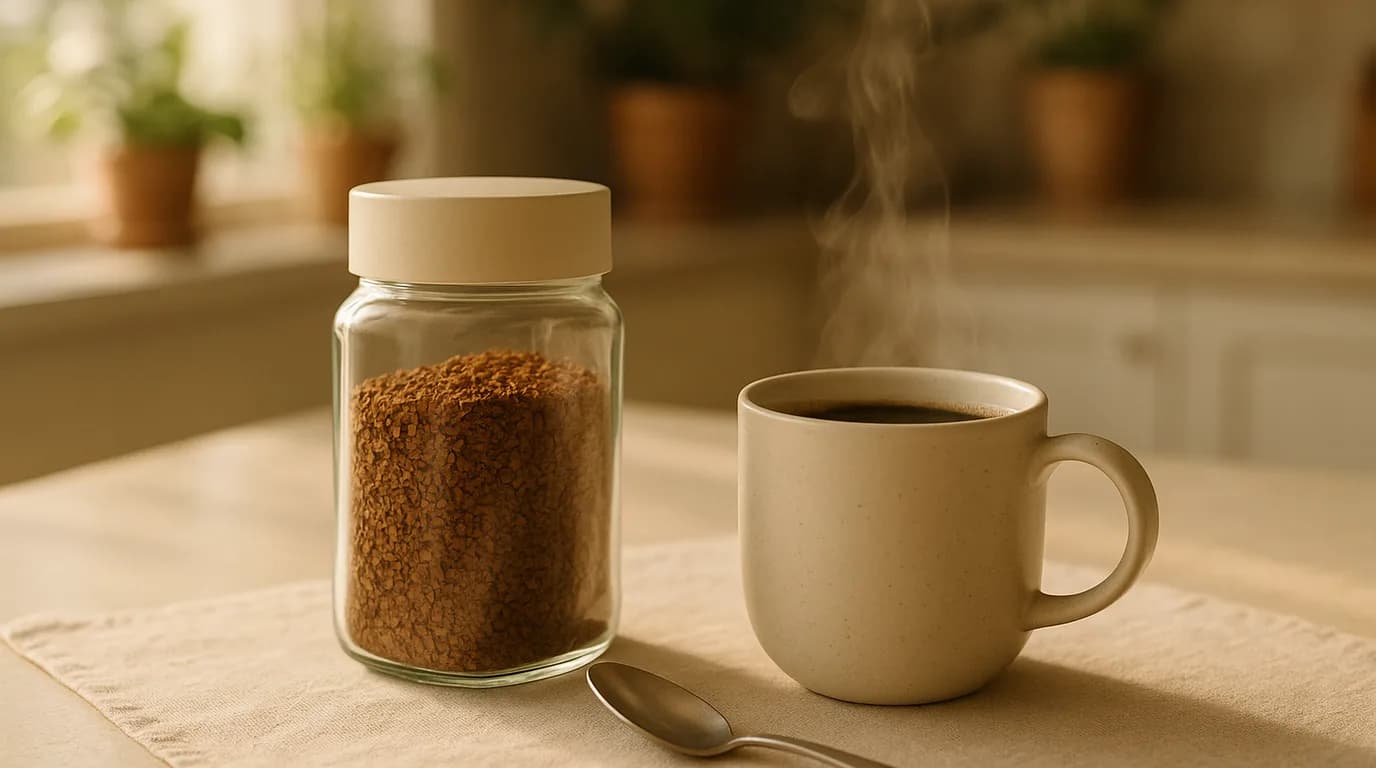
Key Takeaways
- Instant coffee granules are spray-dried or freeze-dried brewed coffee, the solids are not a plastic and do not “contain” microplastics on their own.
- The dominant exposure variables are preparation-stage: a plastic kettle, a plastic cup, or hot water held against plastic all drive far more particle release than the coffee.
- Packaging is where brands differ. Glass jars (Nescafé Clásico, Taster's Choice, Mount Hagen) are inert; Folgers Instant uses a polypropylene canister; single-serve stick packs (Starbucks VIA, Nescafé sachets) are multilayer plastic/foil.
- Dry granules sitting in a plastic canister at room temperature transfer very little, plastic-to-food migration accelerates with heat, acidity, and time, none of which apply until you brew.
- Instant is generally cleaner than plastic pods/K-Cups because it skips the pressurised hot-water-through-plastic step. The fix is the cup, not the coffee: glass or steel kettle + ceramic mug.
Instant coffee & microplastics, the numbers that matter
- water temperature at dissolve
- 90–96°C
- the moment any plastic in the cup, kettle, or stick-pack lining is hottest and most mobile
- Standard brewing guidance
- Folgers instant canister polymer
- #5 PP
- polypropylene AromaSeal canister, dry, room-temperature contact with the crystals
- Folgers packaging disclosure
- Nescafé Clásico / Taster’s Choice / Mount Hagen jar
- glass
- inert borosilicate-family glass, no polymer contact with the granules
- Brand packaging
- particles per drink from a hot paper cup
- ~25,000
- why the vessel (not the coffee) is the real variable
- Ranjan et al. 2021 (J. Hazardous Materials)
- VIA / sachet stick-pack construction
- multilayer
- PET / PE / aluminium laminate, single-use, brief dry contact before pouring
- Food-contact laminate spec
- synthetic microplastics per cup of coffee made from sachets, served in glass
- 10 ± 1
- particles 10 µm and larger; no pod or brewer in the path, and still not zero
- Al-Mansoori, Harrad & Abdallah 2025
Where the microplastics actually come from
“Does instant coffee have microplastics?” is really four questions wearing one coat. The granules are dehydrated brewed coffee, coffee is extracted, then the water is removed by spray-drying or freeze-drying, leaving soluble solids. There is no plastic in that process. So when people find microplastics in a cup of instant coffee, the particles are coming from the things touching the hot water, not from the coffee itself:
- The kettle. A plastic-bodied electric kettle holds near-boiling water against polypropylene or copolyester for minutes at a time. This is usually the single largest contributor in the whole cup, larger than the coffee, the packaging, or the mug.
- The cup. A disposable paper hot cup has a polyethylene (or PLA) lining that releases thousands of particles into hot liquid. A plastic travel mug or a melamine cup adds more. A ceramic or glass mug adds essentially none.
- The packaging, at the moment of use. A single-serve stick pack is a plastic/foil laminate; tipping dry powder out of it is brief and cool, so its contribution is small, but pouring hot water into the sachet (some people do this) is not.
- The water. Tap and bottled water already carry a background microplastic load before the coffee ever touches it. That's a filtration question, covered in our water-filter comparison.
Notice what is not on that list: a pressurised plastic capsule. That is the structural reason instant coffee is generally cleaner than a Keurig K-Cup or a plastic pod, there is no hot, pressurised water being forced through a plastic wall. Our K-Cups explainer covers that worst-case path in detail.
Does the packaging leach into the crystals?
This is the part brands genuinely differ on, so it's worth being precise. Plastic-to-food migration is driven by heat, acidity, fat, and contact time. Dry instant-coffee granules sitting in a Folgers polypropylene canister on a shelf tick none of those boxes: the contact is dry, at room temperature, with a low-surface-area solid. That is about the gentlest contact scenario there is, and measured migration into dry goods under those conditions is very low.
A glass jar (Nescafé Clásico, Nescafé Taster's Choice, Mount Hagen, most supermarket own-brands) removes even that small variable, glass is inert and contributes nothing. So if you want to eliminate packaging as a factor entirely, choose a glass jar over a plastic canister or a plastic-lined pouch. It is a real, if modest, difference, and it's the one thing you can see on the shelf before you buy.
| Brand / product | Packaging | Contact material | Microplastic risk | Verdict |
|---|---|---|---|---|
| Nescafé Clásico / Taster’s Choice | Glass jar | Inert glass | Lowest (packaging) | Cleanest mainstream pick |
| Mount Hagen (freeze-dried) | Glass jar | Inert glass | Lowest (packaging) | Clean + organic |
| Café Bustelo Instant | Glass jar / vacuum tin | Glass or lined tin | Low | Good, check the format |
| Folgers Instant | Plastic AromaSeal canister | #5 polypropylene (dry) | Low (dry contact) | Fine sealed; decant if unsure |
| Starbucks VIA | Stick packs | PET/PE/foil laminate | Low if poured out; brief | Convenient; use a real mug |
| Nescafé sachets / 3-in-1 | Stick packs | PET/PE/foil laminate | Low–moderate | Never brew inside the sachet |
Risk here is the relative packaging + preparation risk, not a measured particle count per brand, no brand publishes one, and the cup and kettle dominate the real number. Formats change by region and year; scan the exact product you own to see how it is built.
What the MicroPlastics app checks
- The packaging polymer of the exact jar, canister, or stick pack you scan, glass, PP, PET, or multilayer laminate.
- Whether the format involves a hot-plastic contact step (pod, lined cup) versus inert contact (glass jar, ceramic mug).
- A 0–100 microplastic risk score so you can compare your instant coffee against your pods, your bottled water, and your kettle.
- Lower-plastic same-category swaps, e.g. a glass-jar instant over a plastic canister, or a steel kettle over a plastic one.
Use the App
Scan your instant coffee, and the cup you drink it from
The jar is only one of four variables. Scan your instant coffee, your kettle, and your travel mug together to see which one is actually driving your exposure, then fix the worst one first.
Scan my coffee setupThe lowest-microplastic way to make instant coffee
You do not need to change brands to cut most of the exposure. In rough order of impact:
- Swap a plastic kettle for stainless steel or glass. This is the biggest single lever. Gooseneck steel kettles are inexpensive and remove minutes of hot-water-on-plastic contact from every cup.
- Use a ceramic or glass mug, never a disposable paper or plastic cup. In a lab soak test a lined paper cup released up to 25,000 particles into hot water (Ranjan et al. 2021).
- Choose a glass jar over a plastic canister or pouch when the brand offers both. Modest, but free.
- Never pour hot water directly into a stick pack. Empty the powder into your mug first, then add water.
- Filter your water. It reduces the background load the coffee is dissolved into, see the best filters for microplastics.
Frequently Asked Questions
Does instant coffee contain microplastics?
Is instant coffee better than K-Cups for microplastics?
Does the Folgers plastic canister leach into the coffee crystals?
Does freeze-dried vs spray-dried instant coffee change the plastic content?
Should I stop drinking instant coffee?
Sources
- Ranjan VP, Joseph A, Goel S. (2021). Microplastics and other harmful substances released from disposable paper cups into hot water. Journal of Hazardous Materials.
- Al-Mansoori M, Harrad S, Abdallah MAE (2025). Synthetic microplastics in hot and cold beverages from the UK market: comprehensive assessment of human exposure via total beverage intake. Science of the Total Environment.
- World Health Organization (2022). Dietary and inhalation exposure to nano- and microplastic particles and potential implications for human health. WHO.
- European Food Safety Authority (2024). Re-evaluation of the risks to public health related to bisphenol A (BPA) in food contact materials. EFSA Journal.
After install · scan this first
Open the camera and scan your instant coffee jar or canister, and the mug.
The jar is only one of four variables. Scan the coffee, the kettle, and the cup together to see which one is really driving your exposure.
Android · early access
Get the launch email the day Android opens.
One email. No spam. We send when the Android app is in the Play Store, and never again unless you opt in.
Related Research
Are Nespresso, Keurig, Lavazza & illy Coffee Pods Plastic? 2026 Brand-by-Brand Microplastic Audit
Five major coffee-pod brands ranked for microplastic exposure: Nespresso Original, Nespresso Vertuo, Keurig K-Cups, Lavazza Modo Mio, illy iperEspresso. Aluminum vs plastic vs compostable: what the polymer disclosure actually says.
Read moreMicroplastics in Iced Coffee: Starbucks, Dunkin, McDonald’s, Peet’s Ranked (Summer 2026)
Iced coffee plastic cups are the worst-case microplastic exposure in any coffee menu: full polypropylene + 20-45 minutes ice-melting contact + acidic + dairy fat extraction. Every major US chain audited with the lower-plastic-contact, same-drink swap.
Read moreBest Reusable K-Cup Pods: Stainless Steel Ranked for 2026
Swap your disposable K-Cup for a stainless-steel reusable pod and take the plastic cup out of the hot-water path. K&J, EcoFlow, Maxware, iPartsPlusMore, SoloFill, Keurig My K-Cup, Cafilas ranked for stainless grade, gasket silicone, Keurig 2.0 compatibility, cleaning, and cost per cup.
Read moreDoes Dunkin’s Coffee Contain Microplastics? Cups, K-Cups, Iced Coffee (2026)
Dunkin’s hot foam cups, iced coffee plastic cups, Original Blend K-Cups, bottled iced coffee, and Dunkin’s bagged ground coffee: every format compared by packaging and use conditions, with lower-plastic-contact, same-drink options for Dunkin’s customers.
Read moreMicroplastics in Oat Milk: Brands Ranked (Oatly, Chobani, Planet Oat, Califia) 2026
Oat milk is the fastest-growing dairy alternative: but every carton is multilayer PE-lined paperboard. Oatly, Chobani, Planet Oat, Califia Farms, Silk, Trader Joe’s, Minor Figures ranked for microplastic exposure plus the lowest-contact fridge-pack vs shelf-stable swaps.
Read moreDoes Starbucks Coffee Contain Microplastics? Cups, Pods, Cold Brew (2026)
Hot coffee bought from coffee-shop chains measured about 16 synthetic microplastics per cup, far below lab soak tests of paper cups. Frappuccino plastic cups, Pike Place K-Cups, VIA instant, cold brew bottles: Starbucks every format audited, with the lower-plastic-contact, same-drink swaps.
Read more