ZeroWater vs Brita for Microplastics: Read the Exact Filter Claims

Last reviewed: by the MicroPlastics Research Desk. Submit a correction or see our editorial standards.
Quick answer
Holding a different bottle? Review its confirmed or estimated material and Product Contact Signal, then compare a lower-contact option.
Scan my product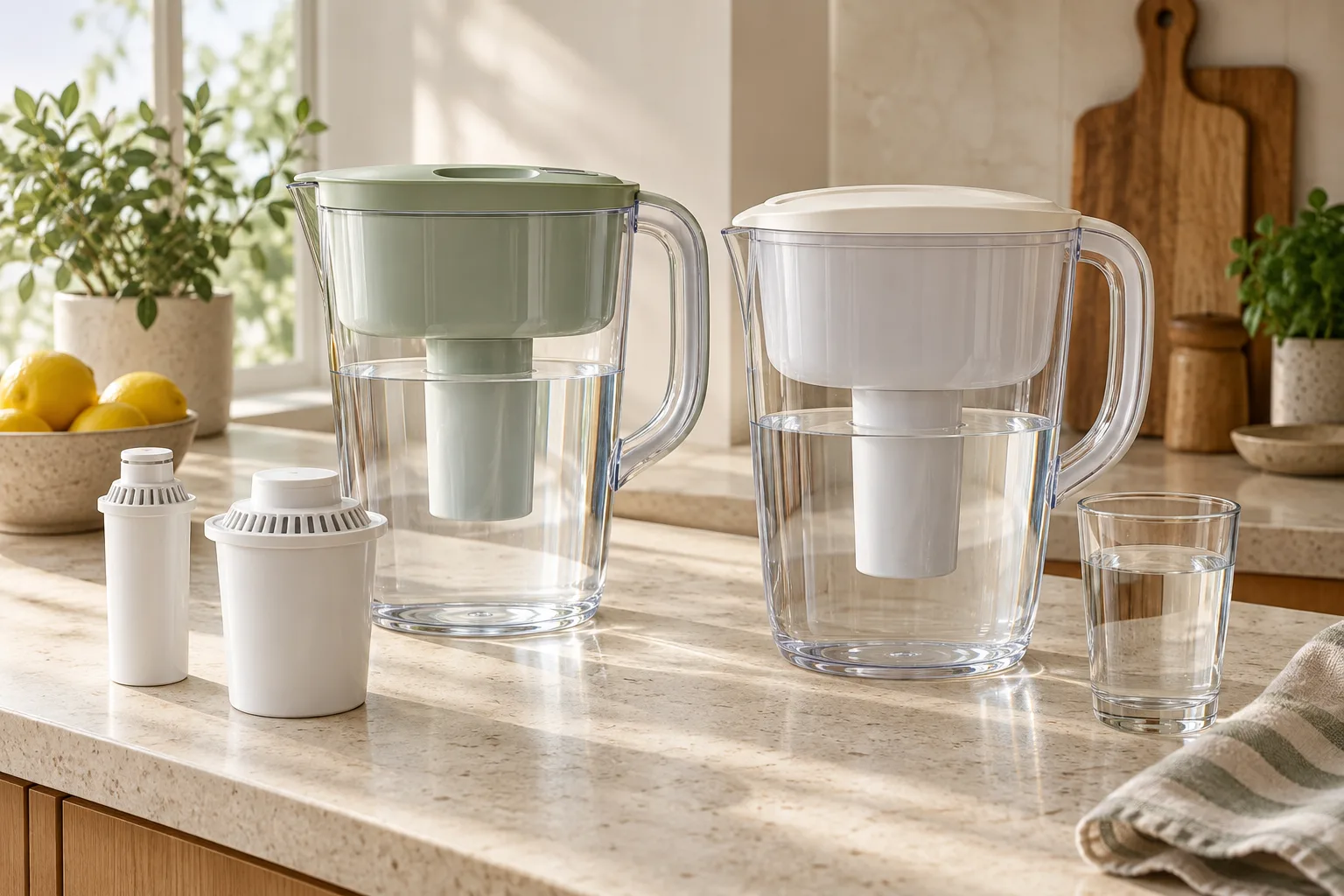
Key Takeaways
- Compare the cartridge and covered system model, not just Brita versus Culligan branding.
- A standard number is insufficient: find the exact microplastics row and its particle-size range.
- The new Culligan ZeroWater filter is incompatible with legacy ZeroWater devices.
- MaxClear has a separate published microplastics claim. It cannot be transferred to a ZeroWater pitcher.
- Filter capacity, source water and maintenance affect the practical decision; a TDS meter does not identify polymer particles.
Start with the replacement filter in your hand
The meaningful comparison is not one brand against another. Brita Standard OB03 and Elite OB06 have different performance sheets. Culligan now sells both legacy ZeroWater replacements and a newer ZeroWater system with a redesigned filter. Its MaxClear gravity system is a third family. A familiar logo or similar reservoir does not make the claims interchangeable.
We checked the manufacturer hubs and linked performance sheets on October 6, 2026. Record the filter code, pitcher or dispenser model and market before shopping. Match those identifiers to the sheet’s covered-system list. A current replacement cartridge offered for one family is not automatically an upgrade for another, and an older comparison can become inaccurate when documentation changes.
The Brita-only guide explains Standard versus Elite in more detail. This comparison focuses on the decision across families: which claim is documented, whether the filter fits, what the meter means and what remains unmeasured.
The current claim matrix
| Filter / system | Listed microplastics claim | Keep the scope attached |
|---|---|---|
| Brita Standard OB03 | No microplastics row in the reviewed sheet | Specified 42/53 claims do not establish microplastic reduction |
| Brita Elite OB06 | 99.6% for 0.5–1 μm; NSF/ANSI 401 row | Published WQA conformance for specified claims and covered systems |
| Legacy ZeroWater ZR001 / ZF201 replacements | No microplastics or Class I particulate row in the reviewed sheet | Legacy covered models and their own listed reductions |
| Current Culligan ZeroWater ZEROFXX replacements | No microplastics or Class I particulate row in the reviewed sheet | Its 401 organic-compound claims are not a microplastics result |
| Culligan MaxClear MCF701 | 96.5% for ≥0.5 to <1 μm; separate 401 row | MCVB, MCVP, MCSB and MCSP only; separate family |
Read the Elite sheet, Standard sheet, legacy ZeroWater sheet, current ZeroWater sheet and MaxClear sheet directly. The distinction is a supported claim versus a claim absent from the reviewed document. An absent row does not demonstrate that a filter captures zero particles. A listed percentage also cannot be generalized to every particle size, every household or a health outcome.
What the Elite result means for the comparison
Elite’s explicit particle-range result provides relevant evidence when that range is the question. It is stronger support than guessing from a loose description such as five-stage, carbon or fine filtration. The same source also limits the conclusion: it reports a defined challenge and system arrangement, not a complete size-resolved analysis of all water leaving every current pitcher.
The result cannot be transferred to Brita Standard. It also does not support the opposite claim that every smaller particle necessarily passes through. Outside the documented range, a claim needs its own experiment. Definitions of microplastics and nanoplastics vary across sources; it is clearer to state the tested dimensions than to promise that an entire named category is gone.
Certification bodies and standard publishers are different entities. The Elite document describes WQA conformance for its specified claims; other certification statements on the sheet have narrower scope. We have reviewed the manufacturer-published document, not independently audited the current certification registry, underlying raw data or a purchased cartridge. Do not simplify that into an unrestricted “NSF certified for everything” claim.
ZeroWater is not MaxClear, even under the same storefront
The Culligan certification hub separates new ZeroWater, legacy ZeroWater and MaxClear documents. A shared storefront can make these distinctions easy to overlook. MaxClear’s own microplastics row supports a claim for its specified gravity systems. It does not supply a result for a ZeroWater replacement cartridge or make those filters compatible.
Similarly, the current ZeroWater sheet includes claims under NSF/ANSI 401 for listed organic compounds. That standard covers multiple endpoints; its presence is not proof that every listed system has a microplastics claim. Look at the substance rows rather than treating a logo or standard number as a universal contaminant-removal badge.
This is also why the comparison should not declare a general health winner. A household might be choosing for a locally relevant metal or another contaminant with its own verified claim. Identify the water-treatment need first, then compare the exact model’s evidence for that need. A particle concern and a dissolved-contaminant concern can require different information.
A TDS meter does not count plastic fragments
Total dissolved solids and suspended polymer particles are different endpoints. A TDS meter does not identify a particle’s composition, count fragments or provide a nanoplastic size distribution. “000” on a consumer display therefore cannot stand in for a laboratory particle result. It also does not certify that every unmeasured chemical or organism is absent.
Culligan’s current support page uses its meter for dissolved-solids monitoring and says to replace the filter when the reading reaches six or more and the orange indicator appears. Treat that as the manufacturer’s maintenance instruction for the relevant system, not a conversion from meter readings to a particle dose. Follow the complete manual as well as the indicator.
A before-and-after meter demonstration may be useful for the endpoint it measures. It cannot show which pitcher performs better for an endpoint it never measured. The same principle applies to taste, clarity and visible sediment: none supplies polymer identification or an analysis of smaller particles.
Capacity and replacement compatibility can decide the practical choice
| Documented filter | Rated capacity | Compatibility check |
|---|---|---|
| Brita Standard OB03 | 40 gallons | Listed Brita systems; confirm your exact pitcher |
| Brita Elite OB06 | 120 gallons | Covered systems in its sheet; do not assume Stream compatibility |
| Legacy ZeroWater ZR001 / ZF201 | 15 gallons in the current linked sheet | Legacy threaded installation |
| Current Culligan ZeroWater ZEROFXX | 20 gallons | New top-down installation, incompatible with legacy |
| MaxClear MCF701 | 50 gallons per filter in its sheet | Separate compatible gravity systems |
The compatibility guide distinguishes legacy filters that twist in from below from new Culligan filters installed from above. Its instructions explicitly say the new filters do not fit the old devices. Check the actual model and part code rather than forcing a cartridge into a similar-looking reservoir.
Rated capacity is not a guaranteed calendar life in every home. Source-water conditions, use and the complete maintenance instructions matter. It is also not a particle-removal score: a larger gallon rating does not establish broader size coverage or better health protection. Cost comparisons should use genuine replacement-filter prices and the correct system family at the time of purchase.
The pitcher and the water source are separate checks
Assess the compatible vessel, lid, reservoir, housing and storage routine as part of the assembled product. A plastic component establishes polymer contact, not a measured amount shed during cold use. A glass vessel changes that contact surface; it does not automatically eliminate every polymer in the filter or certify particle-free output.
Use the system within its specified temperature and water-quality conditions, and follow cleaning, flushing and replacement directions. These documents are not permission to pour boiling water into a pitcher or treat an unsafe water source without the required public-health measures. Filter selection should respond to actual local water conditions, not just a brand comparison headline.
Make the decision by the documented endpoint
If your priority is the particle range expressly tested in the reviewed Elite sheet, OB06 has relevant documentation. If the goal is dissolved-solids reduction, evaluate ZeroWater using its own documentation and maintenance requirements. If considering MaxClear, assess its separate system, claim and capacity rather than importing it into the ZeroWater column.
For smaller particles or another contaminant, request a test that actually covers the question. An appropriate report should identify the exact assembly, test conditions, particle sizes and identification method. No universal home-filter or health ranking follows from the reviewed sheets. The product comparison and Elite evidence profile keep those source limits alongside the construction information.
Frequently Asked Questions
Is ZeroWater better than Brita for microplastics?
Does zero TDS mean zero microplastics?
Are the new Culligan filters compatible with old ZeroWater pitchers?
Does NSF/ANSI 401 always mean microplastics reduction?
Do these sheets prove removal of all nanoplastics?
Sources
- Brita (2026). Current performance-data hub and linked filter sheets. Manufacturer; accessed October 6, 2026.
- Brita (2026). Elite OB06 Performance Data Sheet, Tidal Update. Manufacturer-published test and conformance summary.
- Brita (2026). Standard OB03 Performance Data Sheet. Manufacturer-published sheet.
- Culligan (2026). Current ZeroWater Technology Performance Data Sheet. Manufacturer-published sheet.
- ZeroWater (2026). Legacy ZeroWater Family Performance Data Sheet. Manufacturer-published sheet.
- Culligan (2026). MaxClear MCF701 Performance Data Sheet. Manufacturer-published sheet for specified gravity systems.
- Culligan (2026). Filter compatibility guide. Manufacturer; accessed October 6, 2026.
- Culligan (2026). ZeroWater Technology support and TDS maintenance guidance. Manufacturer; accessed October 6, 2026.
Your next product question
Start with your exact cartridge and compatible pitcher.
Check the cartridge, covered system and specific test claim. TDS readings and another product line’s documentation do not establish your filter’s microplastics performance.
Use the exact product name, model and label to check the information behind an assessment. A photo does not measure particles or personal health risk. The examples above are research subjects, not a verified app-coverage list.
Build a product-routine reading plan →Android · early access
Get the launch email the day Android opens.
One email. No spam. We send when the Android app is in the Play Store, and never again unless you opt in.
Related Research
CamelBak Eddy+: Tritan Renew, Steel and the Bite Valve
Compare two adult Eddy+ models by vessel, cap, straw and silicone valve. Separate recycled-content and BPA claims from particle testing, and follow the complete drinking path.
Read moreHydroJug Traveler: Steel Body, Plastic Drinking Path
Trace the Traveler’s steel vessel, Tritan lid and straw, manufacturer-document inconsistencies, cleaning instructions and the limits of its BPA-free claim.
Read moreDoes Voss Water Have Microplastics? Glass vs Plastic Voss
No study has tested Voss. Three studies found glass-bottled water no cleaner than PET because of the caps, and Voss’s own US report lists US East and West sources alongside Norway. What that means for what you buy.
Read moreDo Plastic Bottle Caps Shed Microplastics? Opening Is the Friction Point
Yes. Direct studies show that opening and closing abrades the cap-neck system. See what changed after ten openings, why the size cutoff matters and when to retire a reused bottle.
Read moreJason Momoa's Mananalu Water: Refillables, Microplastics and the Fine Print
Jason Momoa's Mananalu now uses returnable glass and aluminum bottles. Review the refill model, microplastic claims and questions to ask about finished-water tests.
Read moreSam Leavitt Avoids Microplastics: LSU's Glass-Only Routine, Explained
ESPN says LSU QB Sam Leavitt chooses glass to avoid microplastics. See the original report, glass-versus-steel comparison and habits you can realistically borrow.
Read more