Can You Remove Microplastics From Your Blood? The Evidence

Last reviewed: by the MicroPlastics Research Desk. Submit a correction or see our editorial standards.
Quick answer

Check the products you use most
Scan a few everyday items to see what drives each score and where one swap would help.


Free · 3 scans · iOS and Android
Key Takeaways
- Three human datasets exist on filtering microplastics from blood. The largest has 114 patients; the most chemically specific has 4.
- All three measured blood or filter fluid around a single treatment. None measured tissue, total body burden or health outcomes.
- The plastic in the apheresis kit can add particles. The 2026 Journal of Clinical Apheresis authors say this masked any drop in patients who started low.
- The donation trial people cite was about PFAS, not microplastics: plasma donation every six weeks lowered blood PFOS by 2.9 ng/mL over a year.
- Apheresis is a real medical procedure with real, mostly mild side effects. Severe events are rare in registry data, but they are not zero.
- Blood microplastic tests are not yet standardized, so a before-and-after number is only as good as the assay behind it.
What has actually been measured
- particles per 100 µL, before vs after one plasma exchange
- 52.2 → 21.1
- Only patients starting at 30 or more; company-run study of 114 patients, no control group. Low starters sometimes rose.
- Weinstein et al., J Clin Apher 2026; Circulate release
- tested by pyrolysis GC/MS before and after lipoprotein apheresis
- 4 patients
- Polyethylene fell in all 4, PVC in 3; polypropylene rose in 2 and polystyrene in 1.
- Bornstein et al., Brain Health 2026
- average PFOS drop after 12 months of plasma donation
- −2.9 ng/mL
- 285 firefighters, baseline about 11.1 ng/mL. PFAS chemicals, not plastic particles.
- Gasiorowski et al., JAMA Netw Open 2022
- reported price of one two-hour session at a London clinic
- ~£10,000
- Not available on the NHS. US plasma exchange was quoted at $5,000 to $8,000 per procedure.
- ITV News 2025; E&E News 2026
What clinics are offering, and for how much
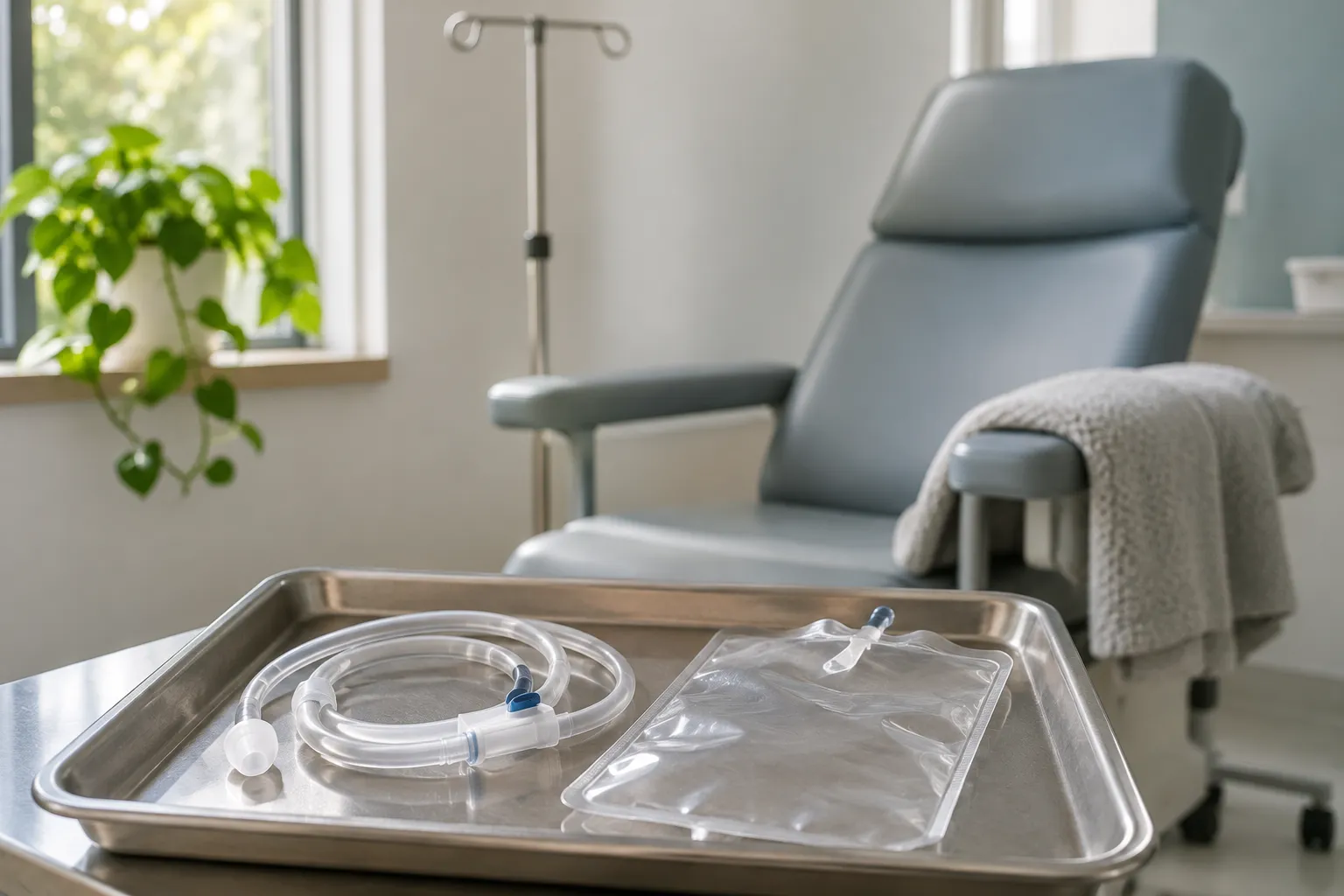
Two procedures are being sold, and they are not the same thing. In therapeutic plasma exchange, a machine separates your plasma (the liquid part of blood) from your cells, discards the plasma and returns your cells with a replacement fluid, usually albumin. In plasma filtering or adsorption, your plasma passes through a filter or a column and goes back into you, minus whatever stuck. Hospitals use both for specific diseases, such as some autoimmune nerve conditions or very high lipoprotein levels. Microplastic removal is not one of those uses.
Clarify Clinics in London was offering its “Clari” procedure by early 2025. ITV News reported a two-hour session costing nearly £10,000, not covered by the NHS, with a company claim of removing 90 to 99% of microplastics and a suggestion it may need repeating every year (ITV, March 2025). The only before-and-after data in that report were the chief executive’s own: 500 particles per millilitre before, 50 after. A GP quoted in the piece said she would not advise patients to have it without evidence. Actor Orlando Bloom’s 2025 Instagram post from the clinic was widely covered, and Dazed later reported that he had used it (Dazed, October 2025).
Clarify’s own site now describes Clari as plasma adsorption through a CE-marked column called the Marker MTx.100. It says the procedure removes particles “greater than 5 microns”, that its device is not FDA-approved, and that its removal charts come from bench tests. It lists no price (Clarify Clinics, accessed November 13, 2026). The 5-micron line matters: smaller particles, including nanoplastics, fall outside that claim.
In the US, Circulate Health offers plasma exchange at affiliated longevity clinics. E&E News reported a price of about $5,000 to $8,000 per procedure in May 2026 (E&E News). Circulate also ran the largest study so far, covered below.
The 2025 Brain Medicine paper: what it did and did not show
The paper most often cited for “apheresis removes microplastics” is a two-page report by Stefan Bornstein, Charlotte Steenblock and colleagues at TU Dresden, published in Brain Medicine on May 20, 2025 (Bornstein et al., 2025). Its 21 patients had ME/CFS and received at least two rounds of double-filtration apheresis for that condition.
The team did not measure patients’ blood before and after. They analysed the fluid trapped by the filter (the eluate) using infrared spectroscopy and compared it with rinse fluid run through a clean filter. Fourteen substances appeared only in patient eluates, with spectra that resembled nylon 6 (polyamide) and a polyurethane. The authors are clear about the limits: the method “does not quantitatively measure” particles, and the polyamide signal could partly come from proteins, which share the same chemical bonds. They call the material “MNP-like” and ask for larger studies with quantitative methods. Three authors work at a German center that sells this apheresis.
That is a fair hypothesis paper. It suggests filters catch something plastic-like. It does not say how much, whether blood levels fell, or whether anyone benefited. A companion commentary in the same journal noted how scarce removal evidence is overall (Fabiano, Luu and Puder, 2025).
The 2026 before-and-after studies
Journal of Clinical Apheresis, June 2026. Researchers mostly affiliated with Circulate Health measured microplastics in the blood of 114 patients before and after 174 single-plasma-volume plasma exchanges (Weinstein et al., abstract). The abstract says plasma exchange reduced circulating particles, but that the reduction was obscured at low starting levels because particles leached back in from the plastic tubing set. The company’s release gives the headline number: among patients starting at 30 or more particles per 100 microlitres, the average fell from 52.2 to 21.1, using a commercial microscopy-based assay called PlasticTox on 100-microlitre samples (Circulate Health, May 2026). The release does not say how many patients were in that high group.
This is a peer-reviewed paper and a real signal. It is also a single-arm study by the company selling the treatment, with samples taken around one session, and an assay whose validation we could not find published. The authors themselves say it does not show that removing particles improves health.
Brain Health, August 2026. The Dresden group followed patients having lipoprotein apheresis for cholesterol that drugs could not control (Bornstein et al., 2026). PFAS chemicals fell by up to 25% after a session in 14 patients. The microplastic results were mixed. In four patients tested by pyrolysis GC/MS, polyethylene fell in all four and PVC in three, but polypropylene rose in two and polystyrene rose in one. A particle-staining method in four other patients showed about a 70% average drop that was not statistically significant and does not confirm the particles were plastic (TU Dresden release). Bornstein said the result does not yet mean the body is rid of them.
Every human dataset on filtering microplastics from blood, side by side
- Source
- Bornstein et al., Brain Medicine, May 2025
- Who and how many
- 21 ME/CFS patients, double-filtration apheresis
- What was measured
- Filter eluate only, by infrared spectroscopy
- Result
- 14 plastic-like substances not in control rinse
- Main limits
- No blood before/after, no amounts, protein overlap; sellers among authors
- Source
- Weinstein et al., J Clin Apher, June 2026
- Who and how many
- 114 patients, 174 plasma exchanges
- What was measured
- Particle counts in 100 µL blood (PlasticTox)
- Result
- 52.2 → 21.1 per 100 µL in high starters
- Main limits
- Company-run, no control, tubing added particles, one session
- Source
- Bornstein et al., Brain Health, Aug 2026
- Who and how many
- Lipoprotein apheresis patients; 4 tested by Py-GC/MS
- What was measured
- Polymer mass in blood before/after
- Result
- PE and PVC mostly down; PP and PS sometimes up
- Main limits
- Tiny sample, mixed methods, acute only
- Source
- Clarify Clinics, ITV report, March 2025
- Who and how many
- One person (the CEO)
- What was measured
- Particles per mL, unnamed test
- Result
- 500 → 50 per mL
- Main limits
- Not published, n=1, method unknown
Why a lower blood reading is not the same as removal
Blood is a moving river, not a storage tank. Particles found in blood are, at best, a snapshot of what is circulating at that moment. The Dresden authors point out that tissue may hold particles that can move back into the bloodstream later. No study has measured whether repeated sessions lower the amount in organs, or whether a blood reading taken weeks later stays down.
There is also no comparison group in any of these studies. Without one, you cannot tell how much a reading would drift between two blood draws anyway, from sampling, lab variation or the day’s exposure. And the equipment is plastic. The clearest finding of the largest study may be that the treatment can put particles in as well as take them out.
What a convincing study would need
None of this means the idea is wrong. Filtering plasma does remove things that circulate in it, which is why hospitals use it for certain diseases and why the PFAS readings in the Dresden patients fell. The question is whether it works for plastic particles in a way that matters. Both research groups list similar next steps, and they are a useful checklist for judging any new claim:
- A comparison group. People who have blood drawn on the same schedule without treatment, or a sham procedure, so normal drift can be measured.
- Blanks for the kit itself. Running clean fluid through the same tubing, bags and filters to count what the equipment adds.
- A validated assay. A published method with stated size limits, polymer identification and checks against fats and proteins.
- Follow-up weeks or months later. To see whether readings rebound as particles move out of tissue.
- Health endpoints. Blood pressure, inflammation, symptoms or events, measured before anyone claims a benefit.
Until a study ticks most of those boxes, a lower number after a session is an interesting observation, not a treatment result. That is also roughly how the authors of the 2026 papers describe their own work.
Can blood microplastic tests be trusted?
Every before-and-after claim rests on the test. The first peer-reviewed blood study, in 2022, found measurable plastic in 17 of 22 healthy donors, averaging 1.6 micrograms per millilitre in positive samples (Leslie et al., 2022). Our guide to that study explains what it can and cannot say.
Since then, an Australian team tried to validate pyrolysis GC/MS for blood and concluded it is not currently suitable for polyethylene and PVC, likely because fats in blood produce similar breakdown fragments (Rauert et al., 2025). That matters here, because polyethylene and PVC are the polymers that fell most in the Dresden data. Microscopy counts, which the US study used, raise different questions: what size cutoff was used, how plastic was told apart from other particles, and what blanks were run.
Units do not convert either. Micrograms per millilitre (mass), particles per millilitre and particles per 100 microlitres (counts) cannot be compared across studies. The October 2026 test of 28 public figures ran into the same problems, which we cover in what the celebrity blood test shows. For lab methods in general, see what a microplastic lab can actually measure.
Does donating blood or plasma remove microplastics?
There is no microplastics study of donation. The trial behind the “donate blood to detox” headlines was about PFAS, the “forever chemicals”, which are molecules that bind to blood proteins, not plastic particles.
In that 2022 randomized trial, 285 Australian firefighters with elevated PFOS were split into three groups for 12 months: plasma donation every six weeks, whole-blood donation every 12 weeks, or no donation (Gasiorowski et al., 2022). From a starting average of about 11.1 ng/mL, PFOS fell by 2.9 ng/mL in the plasma group and 1.1 ng/mL in the blood group, and did not change in the observation group. Only plasma donation lowered PFHxS. The trial did not study health outcomes, and almost all participants were men. If you want the chemistry difference spelled out, our microplastics vs PFAS vs BPA explainer covers it.
It is a well-designed trial and a fair answer for PFAS in a highly exposed group. It tells us nothing about plastic particles, and donated blood and plasma go to patients. Blood services set their own eligibility rules; donate because you are eligible and want to give, not as a treatment.
Risks of apheresis and plasma exchange
Apheresis is generally well tolerated in hospital use, but it is not a spa treatment. The World Apheresis Association registry, covering about 104,000 procedures of several types, recorded adverse events in roughly 2.3% of procedures by 2018 (down from about 11% in 2003), with severe events in about 0.1% (Stegmayr et al., 2021). Low blood pressure was the most common severe event. One death possibly linked to the procedure was recorded, in an elderly, severely ill patient.
Commonly described side effects include dizziness or low blood pressure, tingling from the citrate anticoagulant, and bruising or problems at the needle or catheter site. Clarify’s own FAQ mentions fatigue, headache or body aches lasting from a day to a week. Plasma exchange also removes useful proteins along with the plasma; Clarify markets its adsorption column partly on the claim that it does not remove antibodies or clotting factors. Those trade-offs are worth discussing with a doctor who is not selling the procedure.
The options people ask about, compared
- Option
- Plasma exchange (e.g. Circulate)
- Microplastic evidence
- One company-run study; lower readings in high starters after one session
- Reported cost
- $5,000–$8,000 per procedure (2026)
- Risks and catches
- Procedure side effects; tubing can add particles; no health benefit shown
- Option
- Plasma adsorption (Clarify “Clari”)
- Microplastic evidence
- One unpublished n=1 result; bench tests; only particles over 5 µm claimed
- Reported cost
- Nearly £10,000 per session (2025)
- Risks and catches
- Procedure side effects; not FDA-approved; repeat sessions suggested
- Option
- Blood or plasma donation
- Microplastic evidence
- None for microplastics; lowered PFAS in firefighters
- Reported cost
- Free
- Risks and catches
- Eligibility rules apply; donation is for patients, not detox
- Option
- Cutting everyday contact
- Microplastic evidence
- Lowers what you take in; no study links it to blood levels yet
- Reported cost
- Low to none
- Risks and catches
- Hard to measure the effect in your own body
What to do if you are considering it
- Talk to your own doctor first. Bring the clinic’s written claims and ask whether apheresis is suitable for you at all, given your health and medicines.
- Ask the clinic five questions. Which test do you use and is its method published? What particle sizes does it see? Do you run blanks for your own tubing? What happens to my level after a month? What is the published evidence of a health benefit?
- Treat a lower number as a reading, not a cure. A single post-session blood test cannot show what is in your tissues.
- Spend effort where the evidence is simpler. Reducing heated plastic food contact and choosing sensible water filtration change what you take in, even though no one can yet measure the effect in your blood. Our evidence-based detox guide lists practical swaps, and can you sweat out microplastics covers saunas.
For context on how long particles seem to persist, see how long microplastics stay in your body. The FDA’s current view is that the evidence does not show that the microplastic levels found in foods pose a risk to human health, while research gaps remain (FDA).
Use the App
Start with what goes in, not what comes out
Scan the containers, bottles and packaging you use every day to see which plastics they are made from. The app does not measure plastic in your blood or recommend any medical procedure.
What the MicroPlastics app checks
- Declared or estimated materials in a product and its packaging, part by part.
- Whether the product is meant to be heated, which changes the contact question.
- Published studies on similar materials, with the measured endpoint named.
- A modeled contact signal for saved products, not a blood or tissue measurement.
Frequently Asked Questions
Can plasma exchange remove microplastics from your blood?
How much does microplastic blood cleaning cost?
Does donating blood remove microplastics?
Is apheresis safe?
Are blood microplastic tests accurate?
What did the 2025 Brain Medicine apheresis paper find?
Sources
- Bornstein SR, Gruber T, Katsere D, et al. (2025). Therapeutic apheresis: A promising method to remove microplastics?. Brain Medicine 1(3):52–53, doi:10.61373/bm025l.0056.
- Bornstein SR, Kanczkowski W, Walther R, et al. (2026). Therapeutic apheresis: An effective strategy for a combined targeting of circulating lipoproteins, inflammatory markers, PFAS, and microplastics in cardiometabolic and neurodegenerative disease?. Brain Health, epub August 4, 2026.
- TU Dresden via EurekAlert (2026). News release on the Brain Health apheresis study (cohort sizes and polymer results). EurekAlert.
- Weinstein R, Yuksel ZS, Anderson C, et al. (2026). Can Plasma Exchange Be Used to Lower the Circulating Burden of Microplastics in Human Patients?. Journal of Clinical Apheresis 41(3):e70135.
- Circulate Health (2026). Circulate Health Study Finds Plasma Exchange Removes Microplastics from the Human Bloodstream (press release, May 28). PR Newswire.
- Fabiano N, Luu B, Puder D (2025). Human microplastic removal: what does the evidence tell us?. Brain Medicine.
- Gasiorowski R, Forbes MK, Silver G, et al. (2022). Effect of Plasma and Blood Donations on Levels of Perfluoroalkyl and Polyfluoroalkyl Substances in Firefighters in Australia: A Randomized Clinical Trial. JAMA Network Open 5(4):e226257.
- Stegmayr B, Newman E, Witt V, et al. (2021). Using the World Apheresis Association Registry Helps to Improve the Treatment Quality of Therapeutic Apheresis. Transfusion Medicine and Hemotherapy 48(4):234–239.
- Leslie HA, van Velzen MJM, Brandsma SH, et al. (2022). Discovery and quantification of plastic particle pollution in human blood. Environment International 163:107199.
- Rauert C, Charlton N, Bagley A, Dunlop SA, Symeonides C, Thomas KV (2025). Assessing the efficacy of pyrolysis–gas chromatography–mass spectrometry for nanoplastic and microplastic analysis in human blood. Environmental Science & Technology 59(4):1984–1994.
- ITV News (2025). Would you pay £10,000 to remove microplastics from your blood? (March 28). ITV.
- E&E News (2026). Company verifies first microplastics detox procedure; results vary (May 28). E&E News.
- Clarify Clinics (accessed November 13, 2026). Clari procedure and FAQ. Clarify Clinics.
- Dazed (2025). Is this £10,000 microplastic removal treatment really worth it?. Dazed.
- US Food and Drug Administration (accessed November 13, 2026). Microplastics and Nanoplastics in Foods. FDA.
Your next product question
Start with the food container, bottle or packaging you use most often.
See which plastics touch your food and drink every day. A product assessment does not measure plastic in your blood or recommend any medical procedure.
Use the exact product name, model and label to check the information behind an assessment. A photo does not measure particles or personal health risk. The examples above are research subjects, not a verified app-coverage list.
Read the evidence-based detox guide →Related Research
Microplastics in Human Blood: What the 2022 Leslie Study Found
In 2022 scientists first detected microplastics in human blood: found in 77% of 22 healthy donors. Here is what they found, what it means, and what to do.
Read moreMicroplastics in 28 Famous People’s Blood: What the Test Shows
The Microplastics in Me report found plastic in 27 of 28 public figures’ blood. Who ran it, how Py-GC/MS and flow cytometry were used, why the numbers are shaky, and whether a personal blood test means anything.
Read more