Are Crock-Pots Non-Toxic? Stoneware, Coatings and Lead

Last reviewed: by the MicroPlastics Research Desk. Submit a correction or see our editorial standards.
Quick answer

Check the containers in your kitchen
Scan what you heat and store food in to see what drives each score, and one swap worth making.


Free · 3 scans · iOS and Android
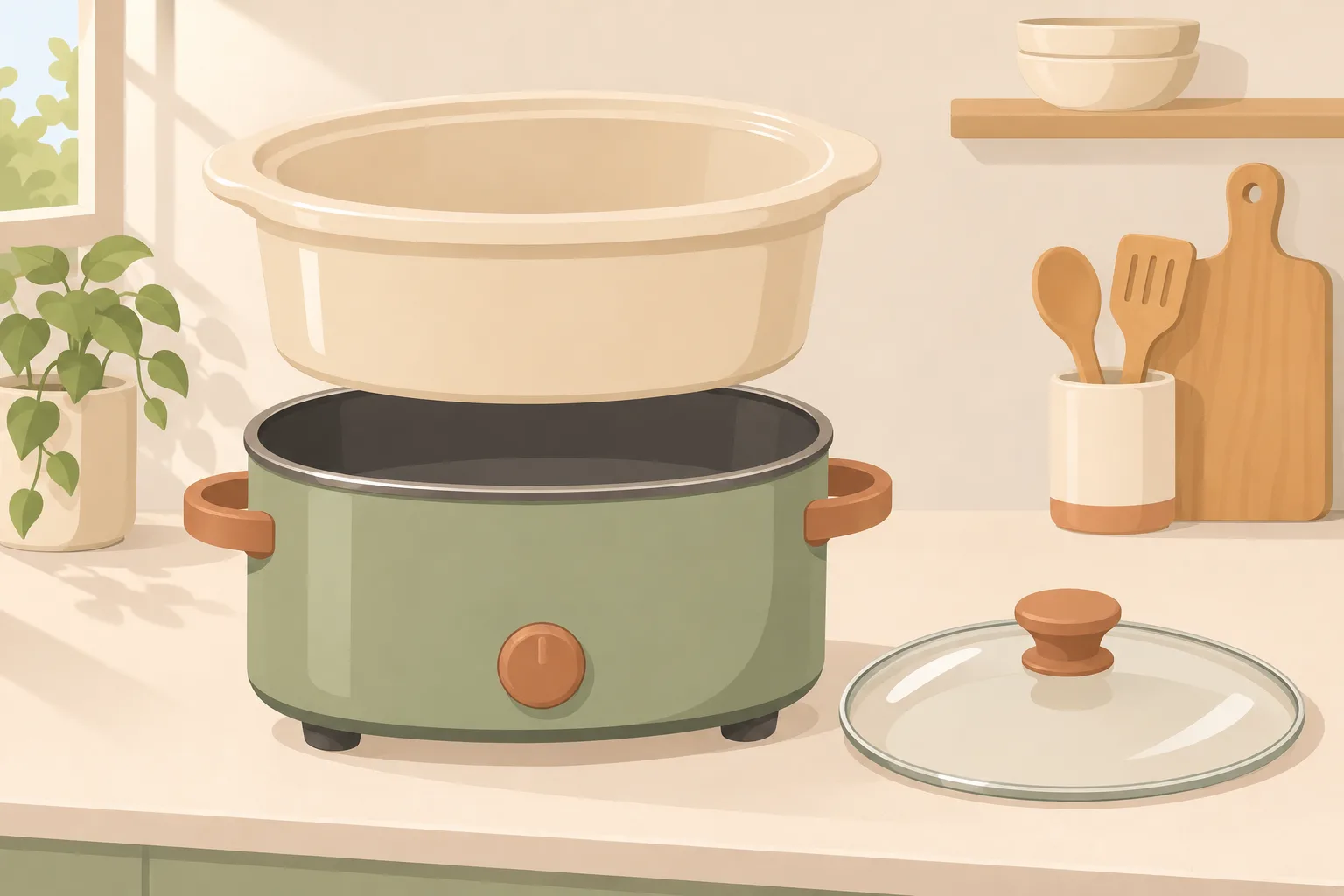
Key Takeaways
- There are now two different products under one brand. Uncoated glazed stoneware, which is the classic Crock-Pot, and stoneware with a nonstick coating on it, sold on the promise that it wipes clean.
- Newell never names the coating chemistry per model. The official manual for the easy-clean models says only “Easy to Clean Non-Stick” and “PFOA-Free Coating”. PFOA-free is not the same as PFAS-free, and the marketing word “ceramic” describes a look, not a disclosed composition.
- PTFE was on Newell’s own disclosure, then came off it. The February 2023 and May 2024 filings both said Crock-Pot slow cookers and pressure cookers “may contain PTFE”, with a note calling it a nonstick surface coating. The May 2026 revision drops PTFE and adds anthracene and DBP. Newell gives no reason.
- Crock-Pot’s PTFE denial is about the glaze only. Its help centre says the glaze on its ceramic pots contains no PTFE or PFOA. That statement is about fired glaze, and does not cover the coated inserts.
- The 2026 lawsuit was about flaking, not lead. The complaint alleges the coating detaches and gets into food. It never mentions lead, cadmium or glaze. The plaintiff withdrew it in June 2026, so nothing was decided.
- Lead in ceramic is a real regulated question, separately. FDA caps what lead may leach out of ceramicware, and a large crock falls under a 1.0 µg/mL action level, measured by an acid soak on six units.
- The lid is tempered glass on the models we checked, so the hot steam surface above your food is glass rather than plastic.
The numbers that actually apply
- FDA lead action level for large ceramic hollowware
- 1.0 µg/mL
- any one of 6 units, by ASTM C738; a crock of 1.1 litres or more falls in this category
- FDA CPG Sec. 545.450
- last Newell disclosure that listed PTFE for Crock-Pot
- May 2024
- the February 2023 and May 2024 filings both say the slow cookers and pressure cookers "may contain PTFE"; the May 2026 revision does not
- Newell Brands chemical disclosures, Crock-Pot
- what Crock-Pot says its glaze is made of
- Quartz, feldspar, clay
- its help centre adds that the glaze "does not contain PTFE & PFOA" and that all its glazes meet or exceed FDA requirements
- Crock-Pot help centre, "Does my Crock-Pot contain Lead?"
- mentions of lead, cadmium or glaze in the 2026 complaint
- 0
- the case is about coating adhesion; we keyword-searched the full 58-page filing
- Ventullo v. Newell Brands, D. Mass. 1:26-cv-10027
- date the plaintiff filed a notice of voluntary dismissal
- June 10, 2026
- the last entry on the docket; no ruling was ever made on the merits
- CourtListener / RECAP docket, read November 22, 2026
- Crock-Pot warranty against defects in material and workmanship
- 1 year
- Sunbeam will repair or replace at its option; normal wear of parts is excluded
- Crock-Pot owner's manual
- lid material on the models we checked
- Tempered glass
- stated in the manual, which also says the stoneware will not withstand sudden temperature changes
- Crock-Pot owner's manual
What the food actually touches
A slow cooker is a simple appliance, which makes this easy to audit. There are only four surfaces that matter, and on a classic model none of them is plastic.
| Part | Material, per the maker | What it means |
|---|---|---|
| The crock, uncoated models | Glazed ceramic stoneware | Vitrified and non-porous. No polymer, nothing to scratch off, and acid does not bother it. |
| The crock, easy-clean models | "Nonstick ceramic coating" over the stoneware. Chemistry not stated anywhere in the manual | A coating is a wear part. This is the one surface on the appliance worth thinking about. |
| Lid | Tempered glass | Sits above the food; condensation runs off glass, not plastic. |
| Outer housing and handles | Stainless steel or painted metal with plastic handles and feet | Never touches food. Not a food-contact question. |
| Carry lids on travel models | A locking plastic lid is used on some Cook & Carry models | Designed for transport, not for cooking. Use the glass lid when the appliance is on. |
The part worth understanding: coated versus uncoated
For most of the appliance’s history, the answer to “is a Crock-Pot non-toxic” was boring and good. The crock was fired ceramic, and nothing else reached the food. That is still true of the plain models, and it is why a slow cooker ranks where it does in our cookware guide.
The “easy-to-clean” line changes the food-contact surface. Crock-Pot’s own marketing for those models, as quoted in the 2026 complaint, describes an easy-to-clean nonstick ceramic coating
that easily wipes clean, requiring less effort to clean by hand compared with traditional stoneware
. In other words, the coating exists to save you a soak, which is precisely the trade we described for slow cooker liners: a small convenience, bought with a new uncertainty.
And the uncertainty here is unusually plain. We read the official owner’s manual for both models named in the lawsuit. It calls the surface Easy to Clean Non-Stick
with a PFOA-Free Coating
, and it never says what the coating is. There is no mention of PTFE, no mention of Teflon, no polymer named at all. Two things follow:
- “PFOA-free” answers a question nobody is asking any more. PFOA was phased out of US nonstick manufacturing long ago. A PFOA-free claim does not tell you whether the coating is a fluoropolymer, and it is not a PFAS-free claim. We unpack that distinction in our PFAS explainer.
- “Ceramic” in nonstick marketing is not the same word as the ceramic your crock is made of. The crock is fired clay. A “ceramic” nonstick coating is usually a silica-based sol-gel layer, and the term is unregulated. We hit the same ambiguity with rice cooker inner pots, where some makers do disclose and some do not.
Which Crock-Pots are coated, and which are not
You can tell from the product page, if you know the phrase to look for. Coated models are sold on cleaning convenience and say so. Plain models just say stoneware.
| Model | Cooking surface, in the maker’s words | Note |
|---|---|---|
| Manual slow cookers, 1.5 to 8 qt | "Removable stoneware", no coating claimed | The classic. Glass lid on the models that name a lid material. |
| 2 qt Classic | "Removable stoneware", oven-safe to 400°F | Lid material not stated on the page. |
| Cook & Carry, 6 and 7 qt | "Removable stoneware" | Adds a locking travel lid. Some pages do not say what that lid is made of. |
| Choose-a-Crock, Casserole Crock | "Stoneware" | Uncoated; lid material not stated. |
| One Touch Control 6 qt Easy-to-Clean | "Nonstick ceramic coating easily wipes clean, requiring less effort to clean by hand compared with traditional stoneware" | Coated. Chemistry not named. Named in the 2026 complaint. |
| 7 qt Easy-to-Clean Cook & Carry | Same "nonstick ceramic coating" wording | Coated. Chemistry not named. Named in the 2026 complaint. |
| MultiMeal multicooker | "Nonstick ceramic-coated pots", which Crock-Pot's own answer calls "not the traditional heavy stoneware crocks" | Coated, and lighter metal pots built for searing. Page claims oven-safe to 450°F. |
| Express Crock pressure cookers | Not stated on the remaining US page; the Canadian manual says "non-stick cooking pot" | The US line appears delisted. Treat as coated and undocumented. |
Crock-Pot’s brand-wide oven and microwave chart says removable stoneware is ovenproof and microwave safe but must never go on a burner or under a broiler, and puts the insert limit at 400°F. That chart is written for stoneware; there is no equivalent chart for the coated inserts, and the MultiMeal page states 450°F for its pots. We are flagging that as a gap in the documentation, not as a safety finding.
What Newell’s own chemical disclosures say, and said
This is the most useful document in the whole category, and almost nobody reads it. California’s cookware law requires manufacturers to publish any intentionally added chemicals that appear on designated state lists. Newell publishes a chemical disclosures index with one PDF per brand. The Crock-Pot file has been revised, and the revisions are informative.
| Version | PTFE listed? | Other chemicals named |
|---|---|---|
| February 28, 2023 | Yes, for "Slow Cookers and Pressure Cookers" | Aluminium, stainless steel constituents |
| May 22, 2024 | Yes, same wording | Aluminium, stainless steel constituents, silicone |
| May 22, 2026 (current) | No | Aluminium, stainless steel constituents, silicone, anthracene, DBP (dibutyl phthalate) |
Both older versions say Crockpot® Slow Cookers and Pressure Cookers may contain PTFE
, and both add a note: PTFE is used due to its high performance as a non-stick surface coating and has FDA approval for food contact applications
. So Newell itself has described PTFE as a nonstick coating in this product family. The current version does not list PTFE, and lists anthracene and dibutyl phthalate instead. Newell publishes no explanation of any of these changes.
Read it carefully, though, because the limits matter as much as the content:
- It is written by product family, never by model number. “Slow Cookers and Pressure Cookers” covers dozens of products with different inserts. Newell’s index page says that where the list is not product or SKU specific, the chemical is contained in all branded products, which cannot literally be true of an uncoated crock.
- “May contain” is doing a lot of work. These filings are written to satisfy a disclosure duty, not to describe one appliance.
- Lead and cadmium have never appeared in any version we read, in either direction. The disclosure lists what is intentionally added from state lists; it is not a glaze analysis.
The honest summary: Newell has disclosed PTFE in this family in the recent past, the current filing does not, and no document anywhere ties a coating chemistry to a specific coated model. If you own an easy-clean Crock-Pot and want to know what is on it, there is no published answer.

Keep going · Chapter 2 of 10
The kitchen: heat, fat and abrasion
Reheating, chopping, frying and washing up: what to replace first, and what is fine to keep.
- One chapter of Less Plastic, Room by Room, 77 pages
- 22 swaps, each with a cost band, and a 30-day plan
- 165 studies cited, to the same standard as this article
Use the App
Check what your crock and lid are made of
Scan a slow cooker, insert or lid to see what the maker declares, whether a nonstick coating is listed, and what to use instead for long cooks.
The 2026 lawsuit, and why it is not a lead case
Search results for Crock-Pot safety now surface a class action, and it is routinely described wrongly, so here is what the filing says. Robert Ventullo v. Newell Brands, Inc. and Sunbeam Products, Inc. was filed in the US District Court for the District of Massachusetts on January 5, 2026, docket 1:26-cv-10027. It names two products: the 7-quart Easy-to-Clean Cook & Carry and the One Touch Control 6-quart Easy-to-Clean slow cooker.
What it alleges. The complaint claims the slow cookers share a defect that causes the nonstick coating to detach, bubble, flake, chip, and peel off
, with migration of nonstick coating into food being cooked
. It offers a mechanism: that the plaintiff’s expert found an excess amount of mica in the Teflon, which creates separation between the Teflon and the ceramic materials
. It further alleges the coating is actually Teflon
, and that calling the product PFOA-free is misleading because consumers will read it as free of all PFAS.
What it does not allege. We keyword-searched the full 58-page complaint. “Cadmium” appears zero times. “Glaze” appears zero times. Lead never appears as a metal, only in phrases like “may lead to”. There is no heavy-metal claim in this case at all, and any article that tells you otherwise has not read it.
Where it ended. We read the docket on November 22, 2026. The last entry, number 16, filed on June 10, 2026, is a notice of voluntary dismissal: the plaintiff withdrew the case. The docket shows no answer from Newell, no motion to dismiss and no ruling, and it does not state why the case was dropped or whether it could be refiled. Some case-tracking sites still list it as pending; that is out of date.
So treat all of the above as one person’s untested allegations, not findings. The only testing described in the filing is unnamed microscopy testing
by a retained expert, and microscopy cannot identify a polymer, so even the claim that the coating is PTFE was never demonstrated. What the case does tell you is narrower, and still useful: coated crocks generate flaking complaints, and the manufacturer does not publish the coating’s composition.
Lead and cadmium in a glazed crock: the honest version
This is the question people actually mean when they ask whether a slow cooker is toxic, and it has a real regulatory answer. Glazes can contain lead, because lead makes glaze flow and shine. So FDA limits what can leach out of finished ceramicware.
| Category | Criteria | Limit (µg/mL) |
|---|---|---|
| Flatware | Average of 6 units | 3.0 |
| Small hollowware other than cups and mugs | Any one of 6 units | 2.0 |
| Cups and mugs | Any one of 6 units | 0.5 |
| Large hollowware other than pitchers | Any one of 6 units | 1.0 |
| Pitchers | Any one of 6 units | 0.5 |
FDA defines large hollowware as a capacity of 1.1 litres or more, so a 4, 6 or 7 quart crock sits in the 1.0 µg/mL row. That category mapping is ours; FDA’s guidance is about ceramicware generally and does not name slow cookers. These are enforcement action levels used to decide whether an article is adulterated, not health-based safe-intake figures. Testing is by ASTM C738, a room-temperature acid soak, which is not a simulation of eight hours of hot stew. Cadmium is covered by a separate guide, CPG Sec. 545.400, whose figures we have not read from the primary document and so do not quote here.
Two things follow from how that test works, and they matter more than any number.
First, total content and leaching are different measurements. You will find published readings for slow cooker crocks given in parts per million, from handheld XRF screening. XRF measures how much of an element is present in the material, including lead fired deep inside a glaze that never meets food. FDA’s limits are in micrograms per millilitre of leaching solution: what actually came out. A ppm figure and a µg/mL limit are different quantities in different units, and comparing them produces a scary sentence with no meaning. The published Crock-Pot XRF readings we found also come from one advocate’s blog, and mostly cover vintage or other-brand units rather than current production.
Second, compliance is an attestation, not published data. Crock-Pot does answer this question directly, in a help centre article titled “Does my Crock-Pot® contain Lead?” It says the company employs rigorous third-party testing
, that the glaze on its ceramic pots is a silicate made of quartz, feldspar and clay
fired at high temperature, that this does not contain PTFE & PFOA
, and that All the glazes that we use meet or exceed FDA requirements
. It also asserts that Our Slow Cookers are safe 100% to use
, which is a marketing sentence rather than a measurement.
Three things about that statement are worth noticing. It is framed as compliance, never as absence: Crock-Pot nowhere says “lead-free”. Cadmium appears only in its description of what FDA regulates, with no cadmium-specific test claim. And it names no lab, no method and no result, so there is nothing to check. Note too that the PTFE and PFOA denial is about the glaze on ceramic pots. On its own wording it does not cover the coated easy-clean inserts, and should not be read as if it did.
Worth saying plainly: there has never been a recall of a slow cooker over lead. Consumer Reports’ general guidance on kitchenware makes the sensible point, which is that metals can enter food when a glaze is poor or a piece is scratched or chipped. That is the actual risk pathway, and it is one you can see.
What we would do
- Buy the plain crock, not the easy-clean one. The uncoated glazed insert has no coating to fail, costs less, and the thing you give up is a ten-minute soak. If you already own a coated model, this is not a reason to panic, only a reason not to replace like for like.
- Retire a crock that is chipped, crazed or flaking. This is the one case where the material question becomes real, for glaze and for coatings alike. A crock is also the cheapest part of the appliance to replace; Crock-Pot sells inserts separately.
- Skip the liner. The crock cleans up with hot water and a soak, and skipping the liner removes the whole polymer question. Our liner audit has the detail.
- Cook with the glass lid, carry with the plastic one. If your model came with a locking travel lid, it is for the car, not for an eight-hour cook.
- Be wary of vintage. Older glazes, older cords and decades of unknown wear are a different proposition from a current unit. A 1970s crock is a lovely object and a poor choice for daily cooking.
What the evidence does not establish
- What is on any specific coated Crock-Pot today. Newell disclosed PTFE for the slow cooker and pressure cooker family through its May 2024 filing and does not in the current one, and no document ties a chemistry to an individual model. A withdrawn complaint alleged Teflon; its only pleaded testing was microscopy, which cannot identify a polymer.
- Why PTFE came off the disclosure. Newell published no explanation, and nothing we found connects the change to the lawsuit or to a reformulation. The dates are all we can report.
- That any Crock-Pot leaches unsafe lead. No independent leach testing of current production is public. The absence of evidence is not reassurance, but it is not evidence either.
- That the flaking defect is real or widespread. It was alleged by one plaintiff, never tested in court, and the case was dropped.
- That a Consumer Reports slow cooker lead and cadmium test exists. Several blogs cite one. We could not find it on Consumer Reports’ own site, so we do not rely on it.
- A number for how much coating, if any, ends up in food. Nobody has measured it.
What the MicroPlastics app checks
- What a scanned slow cooker, insert or lid is made of, according to the manufacturer, including whether a nonstick coating is declared.
- Whether the maker states a coating chemistry at all, which is the gap this product category has.
- Oven, microwave and dishwasher limits from the manufacturer’s own instructions.
- Product information only: the app does not test crocks for lead, measure leaching or assess health risk.
Frequently Asked Questions
Are Crock-Pots non-toxic?
Do Crock-Pots have lead in the glaze?
What is the Crock-Pot lawsuit about?
Is the Crock-Pot nonstick coating Teflon?
Does Crock-Pot say its slow cookers contain PFAS?
Should I throw out a chipped or crazed crock?
Are slow cooker liners worse than the crock?
Is a vintage Crock-Pot safe to use?
Are stainless steel slow cookers better?
Sources
- Robert Ventullo v. Newell Brands, Inc. and Sunbeam Products, Inc. (2026). Class action complaint, D. Mass. docket 1:26-cv-10027, filed January 5, 2026 (allegations, not findings). US District Court for the District of Massachusetts, via ClassAction.org.
- US District Court for the District of Massachusetts (2026). Docket, Ventullo v. Newell Brands, Inc.; entry 16, notice of voluntary dismissal, filed June 10, 2026 (read November 22, 2026). CourtListener / RECAP, Free Law Project.
- Sunbeam Products, Inc. (Crock-Pot) (Retrieved November 22, 2026). Owner's manual, Easy Clean dishwasher-safe slow cookers (material numbers 2125325 and 2125324): tempered glass lid, Non-Stick PFOA-Free Coating, stoneware care, one-year warranty. Newell Brands.
- Newell Brands (PDF dated May 22, 2026). Chemical disclosures, Crock-Pot (current version): lists aluminium, stainless steel constituents, silicone, anthracene and DBP, and does not list PTFE. newellbrands.com.
- Newell Brands (PDF dated May 22, 2024). Chemical disclosures, Crock-Pot (superseded): "Crockpot Slow Cookers and Pressure Cookers may contain PTFE", with a note that PTFE is used as a non-stick surface coating. newellbrands.com.
- Newell Brands (PDF dated February 28, 2023). Chemical disclosures, Crock-Pot (superseded): same PTFE listing and note. newellbrands.com.
- Crock-Pot (Sunbeam Products, Inc.) (Read November 22, 2026). Help centre: "Does my Crock-Pot contain Lead?" — glaze described as a silicate of quartz, feldspar and clay, no PTFE or PFOA, glazes meet or exceed FDA requirements. help.crock-pot.com.
- Crock-Pot (Sunbeam Products, Inc.) (Read November 22, 2026). Support: Oven & Microwave Safety chart — stoneware ovenproof but not under the broiler, never on a burner, inserts to 400F; lid not oven or microwave safe. crock-pot.com.
- US Food and Drug Administration (Issued 1980, last updated 2005). CPG Sec. 545.450, Pottery (Ceramics); Import and Domestic: Lead Contamination, lead leach action levels by ASTM C738. fda.gov.
- US Food and Drug Administration (Retrieved November 22, 2026). CPG Sec. 545.400, Pottery (Ceramics); Import and Domestic: Cadmium Contamination. fda.gov.
- US Food and Drug Administration (Retrieved November 22, 2026). Lead in Food and Foodwares. fda.gov.
- Consumer Reports (Retrieved November 22, 2026). Opt for Safer Kitchenware: on metals in ceramic kitchenware and the role of poor glazing, scratches and chips. consumerreports.org.
Compare your kitchen contact pattern over time
The app turns saved scans into a modeled household contact pattern based on what you cooked in, stored in, and heated this month. The trend describes the assessed mix, not health or bodily exposure.
- iOS and Android
- Current terms in each store
“Really cool to scan stuff around the kitchen and see what's actually in it. The swaps it suggests are realistic.” App Store review · 5.0★
Related Research
The Slow Cooker Liner Is Not a Sandwich Bag
Liners are nylon rated to 400 °F, not polyethylene; the film is nowhere near its limit in a crock. But nylon 6 is made from caprolactam and nylon 66 is not, the manufacturer says only “a blend of nylon”, and that omission decides which migration question applies to dinner.
Read moreBest Non-Toxic Cookware 2026: Cast Iron, Steel, Ceramic, Enamel Ranked
The best microplastic-free cookware for 2026. Cast iron vs stainless vs ceramic-coated vs enamel vs carbon steel: ranked by safety, durability, and price.
Read moreIs the Instant Pot Sealing Ring Safe? Silicone, Heat, Odor and When to Replace It
The Instant Pot ring is food-grade silicone that sits in hot steam every cook. What silicone migration studies show (and why it falls with use), why rings hold odors, Instant’s 12–18 month replacement guidance, the rest of the lid, and gasket-free alternatives.
Read moreNon-Toxic Rice Cookers: What the Makers’ Own Chemical Filings Say
Zojirushi lists PTFE or PFA for its rice cookers, “platinum” included, and a “ceramic” Tiger lists PFAS. Uncoated stainless pots start near $55, and rinsing rice matters more than either.
Read moreWhen to Replace Nonstick Pans: Signs, Studies and Swaps
Replace a nonstick pan when the coating shows bare metal, flakes, warps or stops releasing food. What Tefal, Caraway, GreenPan and HexClad say, what PTFE particle studies measured, the 500°F fume limit, and what to buy next.
Read more