Prince William's Laundry Microplastic Filter: Does It Work?

Last reviewed: by the MicroPlastics Research Desk. Submit a correction or see our editorial standards.
Quick answer

Check the label on your clothes
Scan the fibre label to see its composition and a lower-plastic alternative. The app does not test fabric.


Free · 3 scans · iOS and Android
Key Takeaways
- The documented event was a technology visit. The Earthshot Prize says Prince William toured Matter and joined a hands-on filtration demonstration.
- “Up to 97%” belongs to a defined product test. It should not be expanded into 97% of all laundry microplastics in every home.
- External filters can work, but results vary. Independent studies have reported capture or removal figures from roughly 20% to more than 90% for different designs and test conditions.
- Maintenance is part of performance. A full, bypassed or incorrectly installed filter cannot deliver its headline result.
- The direct benefit is environmental source control. The device keeps a share of wash-derived fibres out of wastewater; it is not a personal detox device.
What Prince William actually did
On January 22, 2026, Prince William visited Matter's headquarters in Bristol. The Earthshot Prize describes Matter as a 2025 finalist and says the Prince took part in a hands-on demonstration of Regen, its filtration technology for capturing fibres released during textile washing. The visit gave the product a public-figure hook, but the useful consumer question is more ordinary: does an external washing-machine filter meaningfully reduce what leaves the drain?
The official account says Matter's technology is used from home laundry to industrial textile production. It also says the household version powers a Bosch and Siemens microplastic filter. Those details establish the relationship among the visit, the technology company and the consumer appliance brands. They do not turn a demonstration into an independent product trial.
That distinction matters because celebrity coverage often collapses several different claims. Visiting a developer is not the same as certifying a product. A product catching fibres is not the same as proving that a wearer absorbed fewer particles. And a high percentage from one test is not automatically the result in every plumbing setup.
Some media reports said filters were installed at royal residences. The public Earthshot account reviewed for this article confirms the visit and demonstration but does not document a home installation. We therefore use the narrower, directly supported description. The article is about the filter Prince William demonstrated, not an inventory of a private residence.
What the 97% laundry-filter claim means
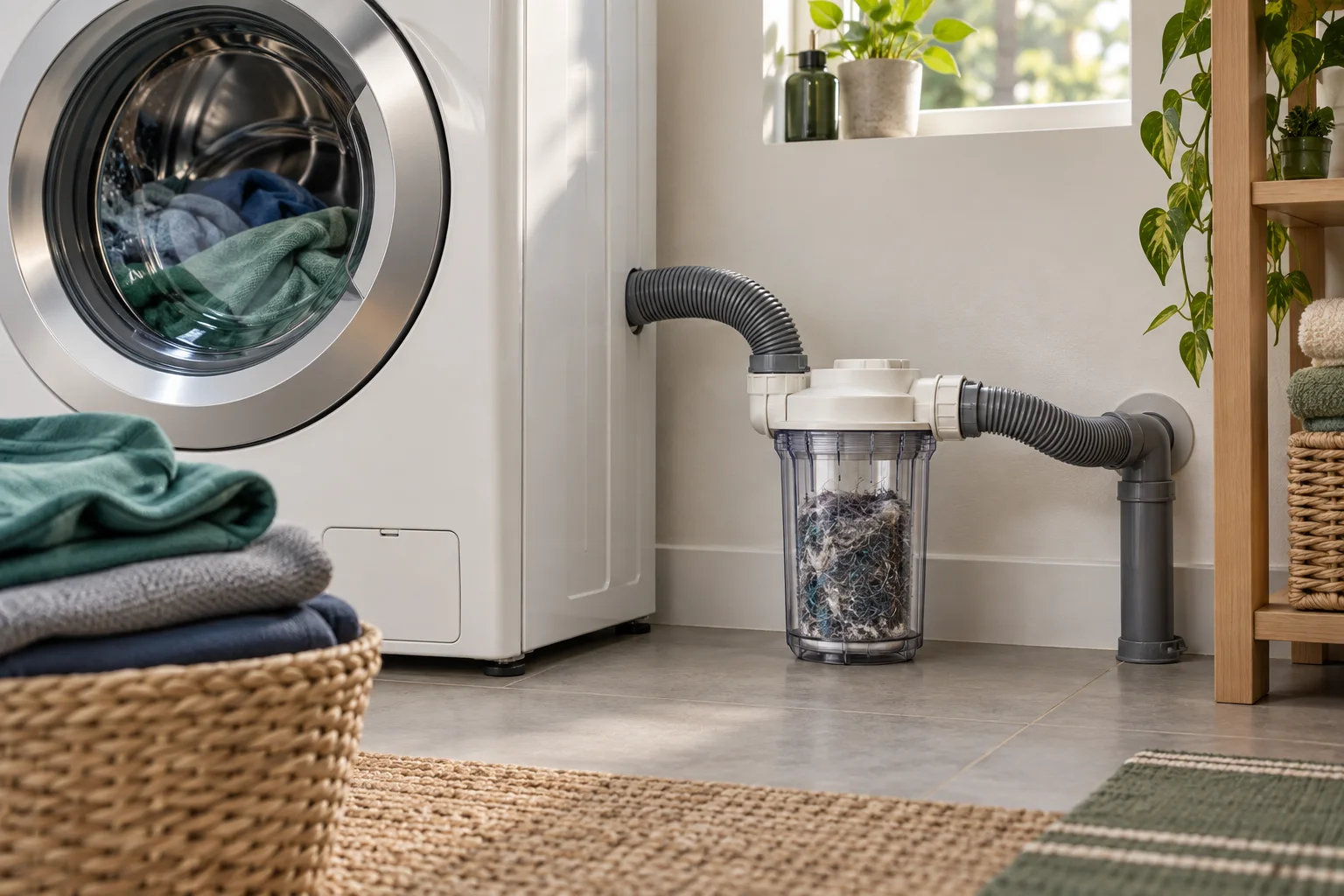
Bosch and Siemens product pages describe an external unit that connects to a washer or washer-dryer and captures up to 97% of microfibres. They say a self-cleaning system moves retained material into a collection chamber, with emptying needed after approximately 20 wash cycles under their stated use assumptions. The design does not require disposable replacement cartridges.
“Up to” is important. A percentage needs a numerator, a denominator and a test boundary. Was performance measured by particle count or fibre mass? Which fabrics were washed? What sizes could the method detect? How much laundry was in the drum? Was the figure averaged across cycles, or was it the best observed result? Those details determine how far the number can travel beyond the original test.
| Claim | What is supported | What it does not establish |
|---|---|---|
| Prince William connection | An official January 2026 visit and hands-on demonstration | Independent certification or a controlled household trial |
| Up to 97% capture | A Bosch, Siemens, Matter and Earthshot product-performance claim | The same result for every fabric, cycle, washer and detectable size |
| Self-cleaning | Captured material is moved from the filtering surface into a chamber | A maintenance-free appliance that never needs emptying or inspection |
| Cleaner water | Fewer captured fibres continue down the household drain | Purified drinking water or removal of every contaminant in wastewater |
| Universal fit | The product is marketed for existing washers and washer-dryers | Compatibility with every installation space, drain arrangement or local requirement |
Independent studies support the idea, not one universal percentage
The strongest case for an outlet filter does not depend on a royal visit. It comes from direct before-and-after measurements of laundry wastewater. In a 2020 study of six fibre-catching devices, Napper, Barrett and Thompson found that the best-performing external prototype reduced release to wastewater by about 78%. A wash bag came second at roughly 54%, apparently by reducing shedding as well as retaining fibres.
Later results show why a single percentage should not represent the entire category. A 2024 study using real laundry wastewater found two commercial filters removed about 19.7% to 24.8% of the microplastics counted under that method, while finer polymeric and ceramic membranes retained particles almost completely. A 2025 study of a different four-stage prototype reported an average around 98.5% across 50 tests.
These findings are not contradictory once the designs and methods are separated. Mesh size, flow, pressure, fibre shape, the analytical size range and whether performance is expressed by count or mass can all change the result. A restrictive membrane can retain more small material while also creating harder engineering problems around flow and fouling.
A 2026 review of external filters identifies biofouling and microbial growth as unresolved practical concerns, especially where wet retained material and organic matter accumulate. The review notes that external laundry filters themselves have not been characterized as thoroughly as other wet washing-machine components. That is a reason for maintenance and further study, not evidence that a particular household filter is unsafe.
What a washing-machine filter changes
Synthetic garments can shed plastic fibres during washing. An outlet filter sits after that shedding has occurred and before the wastewater reaches the household drain. Its direct job is to retain a portion of those fibres so they can be disposed of with solid waste rather than entering the sewer.
Wastewater treatment can retain a large share of incoming particles, but retained material does not simply disappear. Some remains in sludge, and some can pass into effluent depending on the plant and the particles being measured. Source control moves the intervention closer to the release event and reduces the load that later systems must handle.
The device does not make a polyester shirt plastic-free. It does not capture fibres released while a garment is worn, dried or moved around the home. It does not filter the incoming tap water, and it does not measure what an individual inhales or ingests. Those are separate pathways and questions.
This is why the most defensible benefit is environmental: fewer captured fibres leave that wash through the drain. Claims about personal health would require a longer chain of evidence, including exposure pathways, dose and outcomes. The filter can be useful without attaching a medical promise to it.
Use the App
Check the fibre labels in your next laundry load
Save the materials on products you use and compare the contact signals attached to them. The app does not measure fibres in wastewater or verify a filter's capture rate.
Filter, wash bag or a different cycle?
There is no single intervention for every household. An external filter treats the combined wastewater without asking you to separate garments. A wash bag can be used only for selected synthetic items and may reduce abrasion inside the drum. Cooler, shorter cycles can reduce shedding for suitable lightly soiled loads. Buying fewer, longer-lasting garments addresses replacement and production as well as washing.
| Option | Main strength | Ongoing work | Main limitation |
|---|---|---|---|
| External drain filter | Treats the whole wash outflow | Inspect and empty the collector | Cost, space, compatibility and variable performance |
| Fine-mesh wash bag | Low-cost option for selected garments | Sort items and clean the bag | Does not treat the rest of the load |
| Cooler, shorter suitable cycle | No extra hardware and may reduce fibre release | Choose the cycle by soil level and care label | Not appropriate for every hygiene or cleaning need |
| Keep and repair clothes longer | Avoids unnecessary replacement | Care, repair and deliberate purchasing | Does not capture fibres from washing what you own |
One real-world study of consumer laundry found that a 15°C, 30-minute cycle released about 30% less microfiber mass than a conventional 40°C, 85-minute cycle in the tested loads. That does not mean the coldest, shortest program is always adequate. Follow garment labels and use the cleaning conditions needed for illness, allergens, heavy soil or other household requirements.
Loading also mattered in that study: smaller loads with more water per unit of fabric released more fibres by mass than fuller tested loads. Overfilling can prevent cleaning and stress a machine, so the practical rule is to use an appropriate load rather than interpreting the result as permission to pack the drum tightly.
Our broader guide to microplastics in laundry covers garment construction, drying and care. The polyester explainer separates a plastic fibre label from the much harder question of how much a specific garment sheds.
Maintenance decides whether the purchase keeps working
Before buying, look at the drain route behind the washer and the space needed to access the unit. A filter that fits on paper can still be awkward in a shallow cabinet or a machine pushed tightly against a wall. Read the installation instructions for hose height, electrical needs, drainage and permitted washer types.
Then ask where captured material goes. The Bosch and Siemens design says its self-cleaning action transfers material into a collection chamber and can run for about 20 cycles before emptying under the brand's assumptions. Emptying the chamber is still part of ownership. Follow the manufacturer's instructions and keep the collected lint out of the sink and toilet.
A useful maintenance reminder should follow actual household use. Twenty cycles can pass in two weeks for one family and several months for another. If the device provides an alert, treat it as an operational cue. If not, connect the check to a repeatable task such as replenishing detergent.
Watch for leaks, slow drainage, warnings from the washer and visible damage. Stop and follow the product instructions if the setup behaves differently after installation. A percentage in a product listing cannot compensate for a poor connection or an ignored full chamber.
Is the Prince William filter worth buying?
It can be a reasonable source-control purchase for a household that washes synthetic textiles regularly, has a compatible setup and will maintain the collector. The value is clearest when the goal is specific: reduce fibres discharged from the washing machine without sorting every synthetic item into a separate bag.
It is less compelling when installation is impractical, the budget has more urgent uses, or the buyer expects a direct health result that the evidence does not establish. A renter may not be allowed to alter the drain setup. A household that rarely washes synthetics may prefer a bag for a few garments. Availability and pricing also vary by country.
Compare the complete ownership experience: purchase price, installation, space, energy or water use if stated, emptying frequency, warranty and support. Ask whether the 97% figure has a public test protocol that matches the exact product. Independent testing of the retail unit would strengthen the decision.
The celebrity connection is useful because it puts an overlooked pollution route in front of more people. It is not the reason to buy. The best reason is that the appliance fits your laundry routine, you understand what it captures, and you are willing to keep it working.
The evidence-based verdict
Prince William's Matter visit points to a real and technically plausible intervention. External washing-machine filters can reduce fibre emissions into wastewater, and well-designed systems have produced strong results in controlled tests. The category is credible.
The exact number is the part to handle carefully. Published research shows a wide performance range, so “up to 97%” should remain attached to the Matter-powered product and its test conditions. It should not become a universal filter efficiency or a promise of lower human exposure.
If you buy one, treat installation, emptying and disposal as part of the product. If you do not, use suitable cooler and shorter cycles where they clean adequately, wash appropriate loads, keep clothing in use and consider a wash bag for high-shedding synthetics. Those steps can reduce release while the market and independent evidence continue to improve.
What the MicroPlastics app checks
- Declared or estimated fibre and product materials
- The product format and use context you record
- Published references associated with a material assessment
- A modeled Product Contact Signal, not a measurement of laundry wastewater
Frequently Asked Questions
What microplastic filter did Prince William demonstrate?
Does the Matter laundry filter remove 97% of microplastics?
Do washing-machine microplastic filters actually work?
Does a laundry filter reduce microplastics in the body?
How often does the Bosch or Siemens microplastic filter need emptying?
What can I do if I do not buy a washing-machine filter?
Sources
- The Earthshot Prize (2026). Prince William Visits Matter in Bristol: Tackling Microplastic Pollution at Global Scale; January 22, 2026.
- The Earthshot Prize (2026). Matter — 2025 Finalist profile and household filter description; accessed September 9, 2026.
- Bosch Home UK (2026). WMZMPF10 Microplastic Filter — product specifications and manufacturer performance claims; accessed September 9, 2026.
- Napper IE, Barrett AC, Thompson RC (2020). The efficiency of devices intended to reduce microfibre release during clothes washing.
- Song H, Kim YM, Yoo DH, Kim SA, Park C (2026). External Microplastic Filters for Washing Machines: Advances, Technical Challenges, and Biofouling Mitigation.
- Park B, Yoon HJ, Park H (2025). Development and Efficiency Evaluation of Microplastic Removal Filter for Laundry Machines.
- Lant NJ, et al. (2020). Microfiber release from real soiled consumer laundry and the impact of fabric care products and washing conditions.
- Kang J, et al. (2024). Ceramic membranes as a potential high-performance alternative to microplastic filters for household washing machines.
Build a closet audit for microfiber-shed
The app records declared fiber types and laundry-product assessments so future comparisons can reflect what you own.
- iOS and Android
- Current terms in each store
“Really cool to scan stuff around the kitchen and see what's actually in it. The swaps it suggests are realistic.” App Store review · 5.0★
Related Research
Is Polyester Plastic? Yes—Here Is When Clothing Sheds Most
Polyester is usually PET plastic in fibre form. Real-laundry studies show how construction, high-water cycles, load size, temperature, drying and partial-capture devices change shedding.
Read moreMicroplastics in Clothing: The Microfiber Problem
Synthetic laundry sheds up to 700,000 microfibres per load, and shedding rises with wash temperature. Plus why your car cabin is the textile exposure nobody mentions.
Read moreHow Much Microplastic Does Your Laundry Release? (2026 Numbers)
A single synthetic load releases 700,000+ microfibres into wastewater: 87–94% of which water treatment misses. The fabrics that shed worst, the in-machine filters that catch 87–94%, and the $35 bag that catches 70–90%.
Read moreIs Polyester Bad for You? The Fabric Is Inert. The Finish Isn’t.
Polyester itself is inert PET. What reaches the wearer is BPA in some activewear, antimony, allergenic dyes and PFAS finishes — and the OEKO-TEX label allows 200 times more BPA than a 2026 California settlement.
Read moreJason Momoa's Mananalu Water: Refillables, Microplastics and the Fine Print
Jason Momoa's Mananalu now uses returnable glass and aluminum bottles. Review the refill model, microplastic claims and questions to ask about finished-water tests.
Read moreBryan Johnson's Microplastics Routine: The Habits and the Sauna Evidence
Bryan Johnson reports lower microplastic test results. Examine the sauna evidence, detection limits, water habits and what his self-experiment cannot establish.
Read more