Does Smartwater Have Microplastics? Vapor-Distilled, Still Bottled in PET (2026)

Last reviewed: by the MicroPlastics Research Desk. Submit a correction or see our editorial standards.
Quick Answer
Holding a different bottle? Review its confirmed or estimated material and Product Contact Signal, then compare a lower-contact option.
Scan my product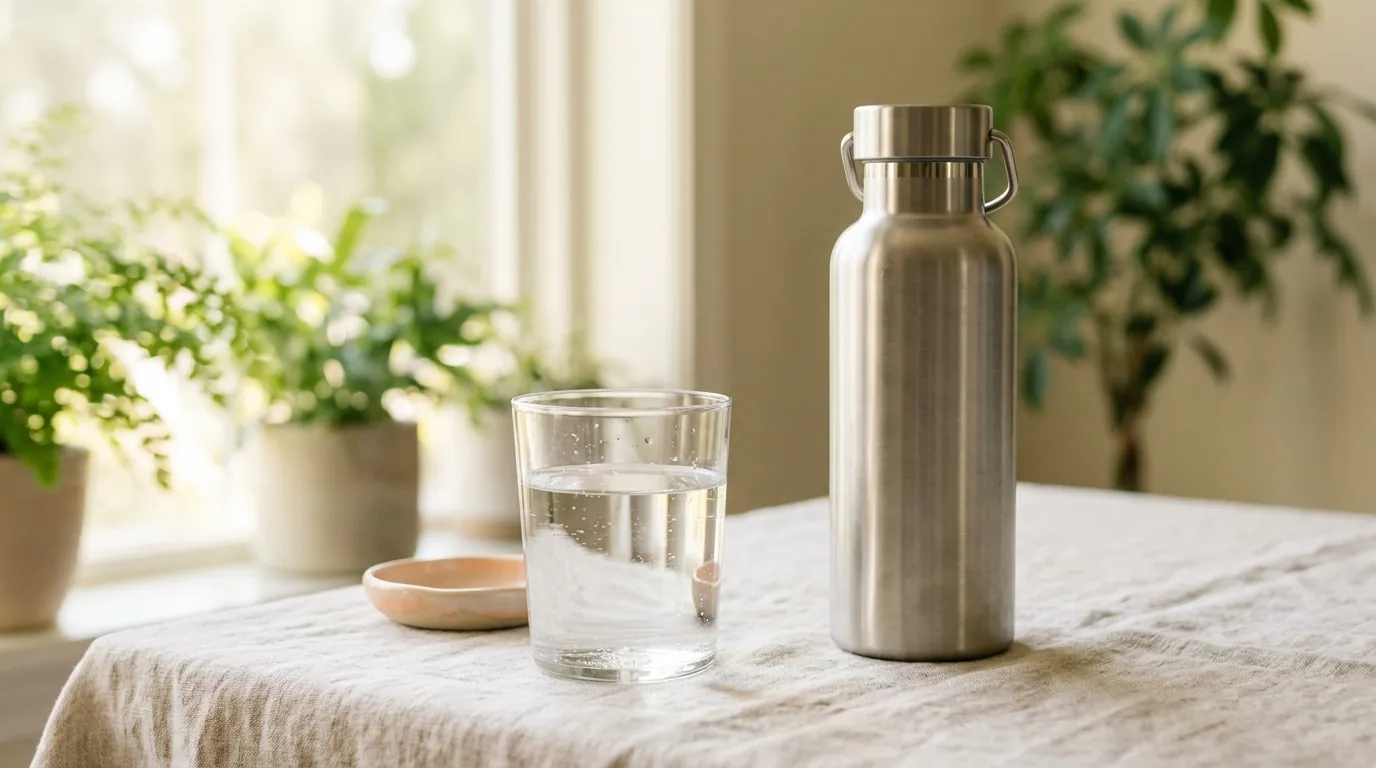
Key Takeaways
- Smartwater is vapor-distilled municipal water with added electrolytes (calcium chloride, magnesium chloride, potassium bicarbonate) for taste, bottled by Coca-Cola in PET (#1) plastic.
- It was not among the 11 brands in Mason 2018, the only major study to name brands. Any exact per-litre figure you see attributed to Smartwater is fabricated.
- The category numbers still apply: bottled water averaged ~240,000 particles per litre in the 2024 PNAS study, about 90% of them nanoplastics small enough to pass into cells.
- Distillation is a genuine advantage over reverse osmosis on one axis: no RO membrane, which PNAS identified as a polyamide nanoplastic source. The PET bottle and cap still shed after bottling.
- Most US Smartwater bottles are now 100% recycled PET (caps and labels excluded). That is a packaging-waste win, not a microplastic one: recycled PET is still PET.
- A home filter into a glass bottle gives you distilled-grade taste control without the bottle that sheds into it.
Smartwater & microplastics: what the research supports
- particles per litre, bottled water average
- ~240,000
- PNAS 2024 tested three common brands; ~90% were nanoplastics
- Qian et al. 2024, PNAS
- Smartwater bottle material
- PET #1
- PET was one of the two most common plastics PNAS found in the water itself
- Coca-Cola / Smartwater packaging
- most common polymer in Mason 2018
- Polypropylene
- the cap material, pointing at packaging rather than source water
- Mason et al. 2018, Frontiers in Chemistry
- Smartwater-specific published count
- Not tested
- not among the 11 named brands in the only named-brand study
- Mason et al. 2018, Frontiers in Chemistry
Does Smartwater contain microplastics?
No lab has published a Smartwater-specific count, so the honest answer starts there: Smartwater was not among the eleven brands in the 2018 study led by Sherri Mason at SUNY Fredonia, still the only peer-reviewed work to name the brands it tested. Across those brands, 93% of 259 bottles showed microplastic contamination, averaging about 325 particles per litre once fragments down to 6.5 microns were counted. No brand tested clean.
The reason that category finding almost certainly extends to Smartwater is mechanical, not statistical. The contamination Mason found pointed at packaging: the most common polymer was polypropylene, the material of the cap, followed by materials consistent with the bottle itself. Smartwater ships in the same PET bottle with the same polypropylene-family closure as the brands that were tested. The 2024 PNAS study pushed the numbers far higher by counting nanoplastics: roughly 240,000 particles per litre across three common (unnamed) brands, with PET among the most common plastics detected in the water. Same bottle, same shedding mechanics.
What vapor distillation does, and what it can't do
Smartwater's marketing hook is “vapor distilled”: the source water (municipal supply) is evaporated and re-condensed, leaving dissolved solids, heavy metals, and most contaminants behind. Then electrolytes are added back for taste. As purification goes, this is thorough, and it sidesteps one problem its purified rivals have: the 2024 PNAS team traced much of the nanoplastic they found to reverse-osmosis membranes, the polyamide filters brands like Aquafina and Dasani run their water through. Distillation doesn't use one.
But distillation happens at the plant, before the water meets the bottle. Every hour after bottling, the PET walls and the cap threads are the water's environment. Heat accelerates the shedding, which matters for a brand sold in gas-station coolers and left in hot cars all summer. Cap abrasion adds more with every twist. Purity of the source water is a claim about what was removed at the plant; it says nothing about what the package adds afterward.
The recycled-bottle wrinkle
Most US Smartwater bottles are now made from 100% recycled PET, caps and labels excluded. That is a genuine packaging-waste improvement and worth crediting. It is not a microplastic improvement: recycled PET is chemically the same polymer as virgin PET and sheds by the same mechanisms. Buying the recycled bottle helps the ocean; it doesn't change what ends up in the water you drink.
Smartwater vs the alternatives
| Option | Microplastic exposure | Note |
|---|---|---|
| Home filter → glass bottle | Lowest | Comparable taste control, no PET, no per-bottle cost |
| Filtered tap in a steel bottle | Lowest | Best everyday default |
| Smartwater (distilled, PET) | High (bottled-water range) | Clean source water; the bottle and cap still shed |
| Purified rivals in PET (Aquafina, Dasani) | High | Same bottle problem, plus the RO membrane mechanism |
See how the whole shelf compares in our bottled water brands ranked guide and the bottled water microplastic database. For the premium-water angle from a spring source instead of a distilled one, our Fiji audit covers the other end of the marketing spectrum.
What to drink instead
- Recreate the purity at home. A certified filter takes tap water to distilled-grade cleanliness for pennies a litre, with no bottle to shed into it.
- Keep the electrolytes if you like them. Smartwater's taste comes from added minerals, not the distillation. A pinch of electrolyte mix in filtered water is the same recipe without the PET.
- Switch the container. A glass or stainless bottle removes the most controllable exposure variable.
Use the App
Scan the water you actually drink
Point the MicroPlastics app at your Smartwater bottle, your reusable, or your filter setup to see the material, the exposure factors, and a cleaner swap.
Get the MicroPlastics appFrequently Asked Questions
Is Smartwater just tap water?
Does distillation remove microplastics?
Is the 100% recycled Smartwater bottle safer for microplastics?
Is Smartwater better than Dasani or Aquafina for microplastics?
Sources
- Mason SA, Welch VG, Neratko J (2018). Synthetic Polymer Contamination in Bottled Water. Frontiers in Chemistry.
- Qian N, et al. (2024). Rapid single-particle chemical imaging of nanoplastics by SRS microscopy. PNAS.
- National Institutes of Health (2024). Plastic particles in bottled water. NIH Research Matters.
- The Coca-Cola Company (2026). Smartwater: vapor-distilled water, ingredients and packaging. drinksmartwater.com.
Track every water source you actually drink
Save bottled brands, filtered tap sources, and travel-water situations to compare a modeled packaging-contact pattern over time. It is not a personal exposure profile.
Download on the App Store- Free on iOS
- 3 free scans
- No sign-up
- Result in seconds
“Really cool to scan stuff around the kitchen and see what's actually in it. The swaps it suggests are realistic.” App Store review · 5.0★
Android · early access
Get the launch email the day Android opens.
One email. No spam. We send when the Android app is in the Play Store, and never again unless you opt in.
Related Research
Does Fiji Water Have Microplastics? The Honest 2026 Answer
Almost certainly yes: like all bottled water. No FIJI-specific lab count exists, but PNAS 2024 found ~240,000 particles/L in bottled water and FIJI ships in PET. The evidence, the 2025 "natural water" lawsuit, and the lower-plastic-contact comparison.
Read moreDoes Aquafina Have Microplastics? Purified Isn't Plastic-Free (2026)
Yes. Aquafina is PepsiCo purified tap water in a PET bottle, and one of the 11 brands in Mason 2018 where 93% of bottles were contaminated. Why the reverse-osmosis purification itself adds nanoplastics, and what to drink instead.
Read moreDoes Dasani Have Microplastics? What's Really in the Bottle (2026)
Yes. Dasani is Coca-Cola purified tap water with minerals added back, sold in PET, and one of the 11 brands in Mason 2018 (93% contaminated). Why the added minerals do nothing for plastic, and the lower-plastic-contact comparison.
Read moreDoes AquaTru Remove Microplastics? Yes: 96.48%, Certified (2026)
The AquaTru Classic is certified to NSF/ANSI 401 for microplastics at 96.48%, plus lead, fluoride, arsenic and PFOA/PFOS. Nothing is certified for nanoplastics.
Read moreDoes Berkey Filter Microplastics? Berkey Hasn't Tested It (2026)
Berkey says it has never tested its elements for plastic particles and cannot claim microplastic removal. The certification record, the EPA stop-sale orders, and gravity-fed pitchers that are certified for microplastics.
Read moreDoes Clearly Filtered Remove Microplastics? Pitcher Verdict (2026)
Yes. Clearly Filtered’s Affinity pitcher is independently lab-tested to remove 99.9%+ of microplastics (tested to NSF/ANSI 42, 53, 401, 473) while keeping beneficial minerals. Tested, not certified, for microplastics; how it compares.
Read more