Bottled Water Brands Ranked for Microplastics (2026)
Last reviewed: by the MicroPlastics Research Desk. Submit a correction or see our editorial standards.
Quick Answer
Holding a different bottle? Review its confirmed or estimated material and Product Contact Signal, then compare a lower-contact option.
Scan my product
Key Takeaways
- The 2018 Orb / SUNY Fredonia study remains the most-cited brand-level dataset; subsequent studies generally confirm the rankings.
- The 2024 Columbia/Rutgers PNAS study did not name brands but found ~240,000 nanoparticles/L across the three tested brands, orders of magnitude higher than older counts.
- Glass-bottled water is not reliably cleaner: French and German studies found as many particles as PET, or more, traced to cap paint and lubricants.
- Bottle material (PET #1) matters more than spring source for typical microplastic count.
- The single biggest reduction is switching from plastic-bottled to filtered tap or glass-bottled water.
The 2018 Orb Media / SUNY Fredonia ranking
Sherri Mason at SUNY Fredonia tested 259 individual bottles from 11 brands purchased in 9 countries. Using Nile-red staining, they identified microplastic fragments and quantified counts per litre. The average across all brands was 325 particles/L, with bottle-to-bottle variation 10-1000×.
| Rank | Brand | Avg particles/L | Notes |
|---|---|---|---|
| 1 (dirtiest) | Nestlé Pure Life | ~10,390 max; ~3,000 avg | Highest single-bottle reading in the study |
| 2 | Bisleri (India) | ~5,200 | Local Indian dominant brand |
| 3 | Gerolsteiner | ~5,160 | German sparkling brand |
| 4 | Aqua (Indonesia, Danone) | ~4,710 | Largest Indonesian brand |
| 5 | Dasani (US, Coca-Cola) | ~1,410 | Major US convenience brand |
| 6 | Wahaha (China) | ~730 | Major Chinese brand |
| 7 | Aquafina (US, PepsiCo) | ~540 | Lower than Dasani in this dataset |
| 8 | Epura (Mexico, PepsiCo) | ~510 | Latin American distribution |
| 9 | Minalba (Brazil) | ~410 | Brazilian regional brand |
| 10 | Evian (France, Danone) | ~256 | Among lowest in the study |
| 11 (cleanest) | San Pellegrino (Italy) | ~74 | Cleanest in the dataset; glass bottles also available |
Note: these are averages from one major 2018 study. Individual bottles vary widely and brands may have changed manufacturing since the study. None of these brands were tested for nanoplastics (<1 µm) because the methods of the time could not detect them.
Popular brands the 2018 study did not test
Several of the brands people ask about most were not among the eleven, and no lab has published a brand-specific count for any of them. A per-litre figure attributed to one of these brands is not from a study. What they share with the tested brands is the container: each ships in a PET (#1) bottle with a polypropylene cap.
- Smartwater: vapor-distilled municipal water. Distillation cleans the water, not the bottle it then sits in. Smartwater's score
- Fiji: the same PET, shipped further and warmer than most. Fiji's score
- Essentia: ionisation changes the water before filling; the bottle is unchanged. Essentia's score
- Core Hydration: the sport cap is opened and resealed far more often than a screw cap, which adds a small amount of closure wear.
- Poland Spring: spring water that has never been included in a published particle study.
Every brand above, tested or not, is in the bottled water brand database, which marks which figures are measured and which are extrapolated from the bottle format.
The 2024 nanoplastic update
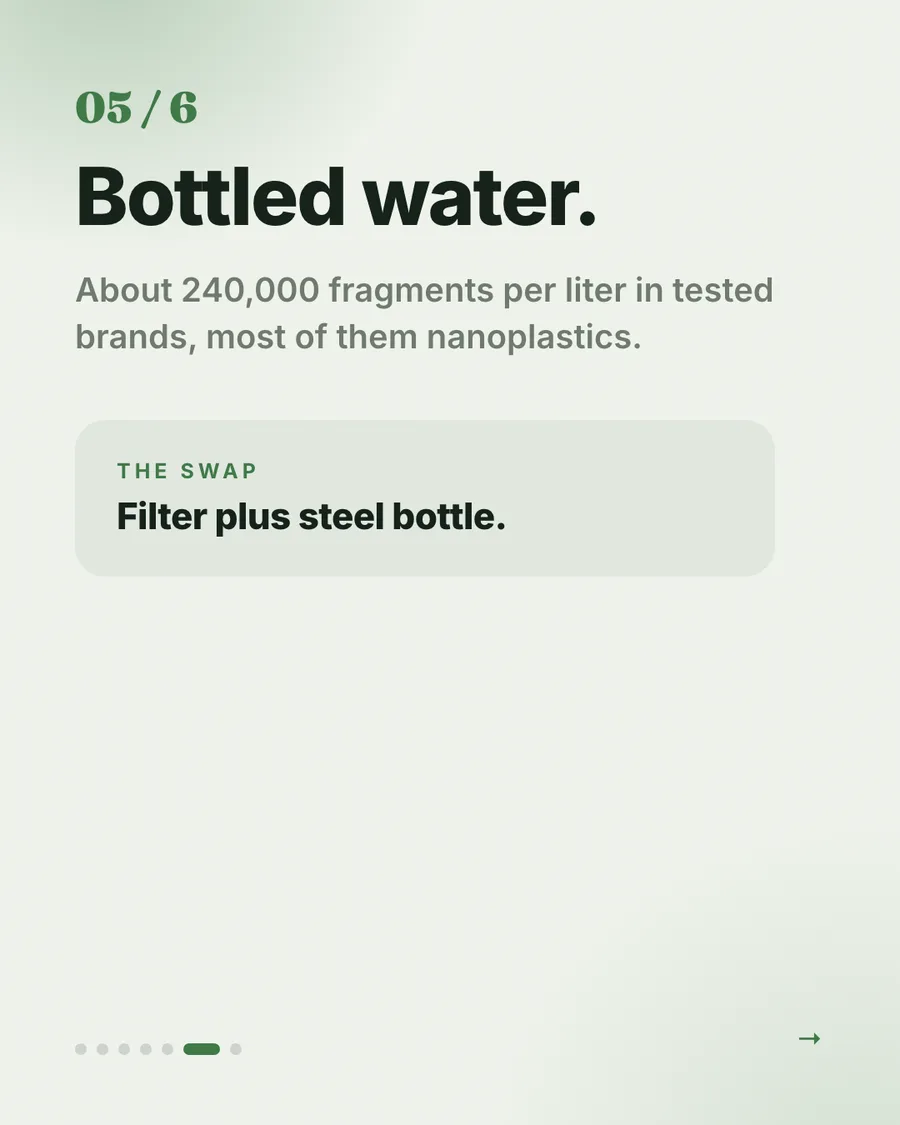
The Columbia/Rutgers PNAS study didn't name brands but tested three popular US bottled waters using stimulated Raman scattering microscopy. Average count: ~240,000 nanoplastic particles per litre. 10 to 100× higher than the Orb Media counts because the new method detects particles below 1 µm. The implication: all the brands in the Orb Media ranking had similar undetected nanoplastic loads.
Glass-bottled water alternatives
The glass itself sheds nothing, but the cap can. France’s food safety agency found 4.5 particles per litre in glass-bottled water and 1.6 in plastic, matching the paint on the caps, and two German studies found the same direction. None of these brands has a published microplastic test, so choose glass for taste or reuse, not as a guarantee. See does Voss water have microplastics? for the evidence. Glass-bottled brands:
| Brand | Source | Availability | Price |
|---|---|---|---|
| Voss Artesian Glass | Norway; US East and West sources (per Voss) | Wide US/EU upscale grocers | $3-5/750 ml |
| Mountain Valley Spring Glass | Arkansas, USA | Whole Foods, online subscription | $2-3/1L |
| San Pellegrino (glass) | Italy | Wide; restaurant default | $2-4/750 ml |
| Ferrarelle Glass | Italy | Italian groceries; online | $3-4/750 ml |
| Saratoga Spring Glass | New York, USA | Cobalt-blue bottles; specialty stores | $3-4/750 ml |
| Acqua Panna (glass) | Italy | Restaurant default; some grocers | $2-4/750 ml |
The smarter long-term answer
Even the cleanest glass-bottled water costs more per gallon than any filtered tap water. For daily hydration, the most cost-effective and lowest-microplastic option is filtered tap water in a glass or stainless steel bottle. Glass-bottled commercial water makes sense for restaurants, special occasions, and travel. Canned water such as Liquid Death removes the plastic bottle wall but keeps a thin polymer liner inside the can.
See: best water filter for microplastics, best glass water bottles, and microplastics in bottled water.
What the MicroPlastics app checks
- Bottled drink material. PET, HDPE, glass, aluminum, multi-layer carton.
- Container condition signals from the photo, dents, scratches, label wear.
- Brand, product category, and SKU variant.
- Use-context flags you log, heat exposure, reuse, storage time.
- Linked published research behind the 0–100 risk score.
Use the App
Scan bottled drinks and water products before you buy
Tap the barcode and snap a photo. The MicroPlastics app weighs packaging material + brand + container condition and gives a 0–100 risk score with a safer alternative.
Scan water products in the appFrequently Asked Questions
Which bottled water has the most microplastics?
Which bottled water has the fewest microplastics?
Is Aquafina or Dasani worse for microplastics?
Are glass-bottled brands like Voss and San Pellegrino really cleaner?
Is sparkling water worse for microplastics?
What is the cheapest microplastic-free water?
Sources
- Mason SA, Welch VG, Neratko J. (2018). Synthetic polymer contamination in bottled water. Frontiers in Chemistry.
- Qian N, Gao X, Lang X, et al. (2024). Rapid single-particle chemical imaging of nanoplastics by SRS microscopy. PNAS.
- World Health Organization (2019). Microplastics in drinking-water. WHO.
- Schymanski D, Goldbeck C, Humpf HU, Fürst P (2018). Analysis of microplastics in water by micro-Raman spectroscopy. Water Research.
After install · scan this first
Open the camera and scan whatever bottled water is in your fridge.
See your usual brand alongside lower-PM alternatives, ranked by particle count per litre.
Android · early access
Get the launch email the day Android opens.
One email. No spam. We send when the Android app is in the Play Store, and never again unless you opt in.
Go deeper
Less-travelled research from our archive that follows directly from this page.
Related Research
Best Stainless Steel Water Bottles 2026: Microplastic-Free Picks
The best stainless-steel water bottles for 2026, ranked. Klean Kanteen, Hydro Flask, MiiR, Owala, Stanley, Yeti: compared on microplastic exposure, insulation, lid type, and price.
Read moreBest Glass Water Bottles for 2026: Ranked for Microplastic Safety
Glass water bottles eliminate microplastic leaching entirely. Here are the best borosilicate and soda-lime glass bottles for 2026, ranked by safety, durability, and price.
Read moreInternational Report: Microplastics in Drinking Water (2026)
The 2026 international report on microplastics in drinking water: WHO, PNAS, EPA findings, regions with highest contamination, and what it means for you.
Read moreWhich Country Has the Most Microplastics in Tap Water? (2026 Global Ranking)
Tap-water microplastic levels range from <1 to 1,500+ particles per litre worldwide. The 2026 country-by-country ranking with WHO baseline, regional studies, and what drives the gap between the lowest-contact and dirtiest taps.
Read moreBottled Water Microplastics: What to Drink Instead
A 2024 PNAS study counted ~240,000 plastic particles per liter in bottled water: 90% nanoplastics. Why bottles shed, what raises risk, and what to drink instead.
Read moreMicroplastics in Tap Water: Is Your Drinking Water Safe?
94% of US tap water samples contain microplastics. What actually removes them, why the boiling trick only works in hard water, and which filter certification to look for.
Read more