Best Water Filter Pitchers Ranked for Microplastics (2026)
Last reviewed: by the MicroPlastics Research Desk. Submit a correction or see our editorial standards.
Quick Answer
Holding a different bottle? Review its confirmed or estimated material and Product Contact Signal, then compare a lower-contact option.
Scan my product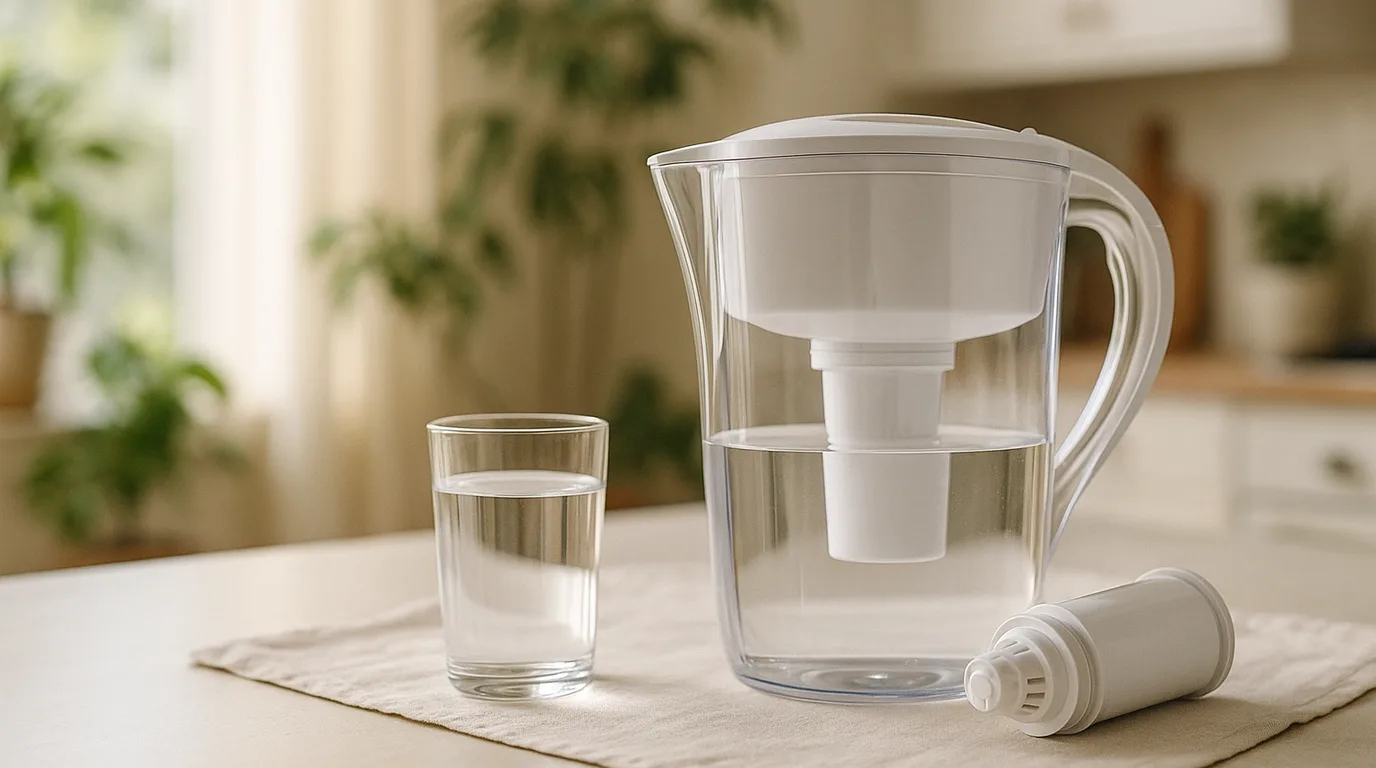
Key Takeaways
- Three pitchers are certified for microplastic reduction under NSF/ANSI 401: PUR PLUS (99.8%, IAPMO R&T), Brita Elite (99.6%, WQA) and LifeStraw Home Glass (at least 99%, WQA).
- Clearly Filtered, Epic Pure XP and Aquagear publish microplastic results of 99.9% and above, but from lab testing, not certification. Clearly Filtered's only NSF certifications are for chlorine taste and odour and lead-free materials.
- ZeroWater is certified for lead, chromium-6, PFOA/PFOS and mercury, not for microplastics.
- The standard white Brita filter is certified only for chlorine, taste, zinc, cadmium, copper and mercury. No lead, no microplastics.
- Pitcher body material matters too: most are plastic; a glass-bodied pitcher removes the last plastic-contact source apart from the cartridge.
Certified or just tested: the distinction that decides this list
Every pitcher filter uses some combination of granular activated carbon, ion-exchange resin and, in the better cartridges, extra layers such as carbon block or chelating media. For microplastics, what matters is how small a particle the media traps, and whether anyone independent has checked the claim.
NSF/ANSI 401 is the standard that carries a microplastics claim: the filter must remove at least 85% of particles 0.5–1 µm across. Certified means NSF, WQA or IAPMO R&T lists the product for that claim, which involves their own testing and ongoing audits of the product. Tested to means the manufacturer paid a lab to run the protocol, and nobody checks production units afterwards. Tested results can be perfectly real; they are just a weaker kind of evidence, so this ranking puts certified microplastic claims first.
Pitcher filters ranked, September 2026
| Rank | Pitcher | Microplastic claim | Certified for | Cartridge life | Cost / gallon |
|---|---|---|---|---|---|
| 1 | PUR PLUS (PPF951K cartridge) | 99.8%, certified | NSF 42, 53, 401 (IAPMO R&T), incl. lead and PFAS | ~40 gal | $0.20-0.30 |
| 2 | Brita Elite (formerly LongLast+) | 99.6%, certified | NSF 42, 53, 401 (WQA), incl. lead | ~120 gal | $0.15-0.20 |
| 3 | LifeStraw Home, glass 7-cup | At least 99%, certified | NSF 42, 53, 401 (WQA) | ~40-264 gal (two-stage) | $0.20-0.30 |
| 4 | Clearly Filtered Pitcher | >99.99%, lab-tested | NSF 42 (chlorine) and 372 (materials) only | ~100 gal | $0.30-0.45 |
| 5 | Epic Pure XP | 99.9%, lab-tested | NSF 42 and 372, material safety only | ~150 gal | $0.20-0.30 |
| 6 | Aquagear Pitcher | 99.99%, lab-tested | None listed | ~150 gal | $0.20-0.30 |
| 7 | ZeroWater 10-Cup | No claim | NSF 42, 53 (IAPMO): lead, chromium-6, PFOA/PFOS, mercury | ~25 gal (TDS-dependent) | $0.45-0.65 |
| 8 | Brita Stream | No claim | NSF 42, 53 | ~40 gal | $0.15-0.20 |
| 9 | Brita Standard (white filter) | No claim | NSF 42, 53 (WQA): chlorine, zinc, cadmium, copper, mercury | ~40 gal | $0.10-0.15 |
| 10 | Soma Glass Pitcher | No claim | NSF 42, 53 | ~40 gal | $0.20-0.30 |
Certification status for ranks 1-7 and 9 was checked on 21 September 2026 against the NSF, WQA and IAPMO R&T public listings and each maker's performance data sheet; see the sources below. The LifeStraw certification covers the glass 7-cup pitcher only, not the plastic Home Essential models. Cost per gallon includes pitcher amortisation over 3 years.
PUR PLUS, the cheapest certified microplastic claim
The PUR PLUS cartridge (PPF951K) is certified by IAPMO R&T to NSF 42, 53 and 401, and its current performance data sheet lists 99.8% microplastic reduction alongside lead and total PFAS. Two catches. It is rated for about 40 gallons, so it is the most frequent change of the certified three. And it is the PLUS cartridge specifically: the basic PUR filter is not certified for microplastics, so check the model number when you reorder.
Brita Elite, the upgrade every Brita owner should make
The Elite cartridge (model OB06) is certified by WQA to NSF 42, 53 and 401, and Brita's own data sheet lists 99.6% reduction of microplastic particles 0.5–1 µm, plus lead. It lasts about 120 gallons, three times the standard filter, and it fits the same pitchers. If you already own a Brita, swapping the cartridge is the single highest-impact change you can make.
LifeStraw Home glass pitcher, certified and glass-bodied
The glass 7-cup LifeStraw Home is certified by WQA to NSF 42, 53 and 401, with a certified minimum of 99.0% microplastic reduction (the brand advertises 99.999%; the certified figure is the lower one). It is the only certified option here with a glass body, so the water sits in glass rather than plastic. The plastic Home Essential pitchers are tested, not certified.
Clearly Filtered, the broadest lab data
Clearly Filtered publishes the widest set of lab results in the category and reports more than 99.99% microplastic reduction. Those results come from a testing lab, not a certifier: its NSF certifications cover only chlorine taste and odour (NSF 42) and lead-free materials (NSF 372). That does not make the lab numbers wrong, but it puts it behind the three certified pitchers here. Trade-offs: a slow flow rate and pricier cartridges. More detail: does Clearly Filtered remove microplastics?
Epic Pure XP and Aquagear, tested but not certified
Both are sold direct at a similar price, with cartridges rated for roughly 150 gallons, and both publish lab results against NSF 42, 53 and 401 including microplastics (Epic 99.9%, Aquagear 99.99%). Neither holds a certification for those claims: Epic's NSF listing covers material safety only, and Aquagear is not listed by any of the three certifiers. Epic Pure is now sold as Pure XP.
ZeroWater, certified for lead and PFAS, not microplastics
ZeroWater's 5-stage cartridge is certified by IAPMO R&T to NSF 42 and 53 for lead, chromium-6, PFOA/PFOS and mercury, and it strips total dissolved solids to near zero (a TDS meter comes in the box). It makes no microplastic claim at all. The catch is cartridge life: around 25 gallons in high-TDS water, which makes it the most expensive per gallon. Best fit: hard water, or lead and PFAS as the main worry.
Standard Brita, the most popular, the weakest
The standard white Brita cartridge is the best-selling pitcher filter in the world and the weakest of the category for this purpose. It is certified for chlorine, taste and zinc (NSF 42) and for cadmium, copper and mercury (NSF 53): not lead, not PFAS, not microplastics. It is still better than unfiltered tap for taste, but if microplastics are the goal, the Elite cartridge is a step change. The Brita-specific answer is in do Brita filters remove microplastics?
What about the pitcher body itself?
Every pitcher in this category uses some plastic, most are BPA-free Tritan or polypropylene. Two things help:
- Refrigerate the pitcher, don't leave it on the counter. Cold storage slows polymer migration into the filtered water.
- Don't use the pitcher for hot water. Filter cold, heat separately. Hot water speeds up migration from any plastic, and pitchers and cartridges are not rated for it.
- For the cleanest body material, consider a glass-bodied pitcher, such as the certified LifeStraw Home glass model. The cartridge is still plastic, but the water sits in glass between pours.
Pitcher vs RO vs under-sink, when to choose which
Pitchers shine when:
- You rent or can't modify plumbing.
- You drink under ~2 gallons of filtered water per day.
- You want the lowest upfront cost ($30-80).
- Refrigerator door space is limited.
Reverse osmosis becomes the better choice when:
- You need PFAS, fluoride or arsenic removal beyond what a pitcher cartridge is certified for. (No filter of any type is certified for nanoplastics.)
- You drink > 2 gallons per day (cost per gallon drops fast).
- You also want filtered cooking and ice water on tap.
See our best reverse-osmosis systems guide for the next tier up.
The right pitcher for your situation
- Want a certified microplastic claim at the lowest price? PUR PLUS, or Brita Elite if you already own a Brita.
- Want certified and glass-bodied? LifeStraw Home, glass 7-cup.
- Want the broadest lab data and accept tested, not certified? Clearly Filtered.
- Hard water, or lead and PFAS as the main worry? ZeroWater, knowing it makes no microplastic claim.
See also: water filters compared brand-by-brand, and microplastics in tap water by US state.
What the MicroPlastics app checks
- Pitcher body material. Tritan, polypropylene, glass.
- Cartridge brand, model, and the published NSF certifications.
- Replacement schedule signals you log against actual cartridge life.
- Heat / sunlight / reuse flags for the pitcher body.
- 0-100 risk score with safer same-category alternatives.
Use the App
Scan your pitcher and cartridges before the next order
The cartridge inside your pitcher determines what you actually filter. Tap the barcode and the MicroPlastics app surfaces the certifications, brand record, and a 0-100 risk score with the safer same-category alternative.
Scan pitcher filters in the appFrequently Asked Questions
Do water filter pitchers remove microplastics?
Which water filter pitcher is best for microplastics?
Is ZeroWater better than Brita for microplastics?
Can a Brita filter remove microplastics?
How long do pitcher filter cartridges last?
Are filtered-water pitchers safe to leave on the counter?
Is a glass pitcher worth the extra cost?
How do I know when to replace the cartridge?
Sources
- NSF International (2024). NSF/ANSI 401: Drinking Water Treatment Units: Emerging Contaminants. NSF.
- Brita (2026). Performance data sheet: Brita system with Brita Elite filter (NSF/ANSI 42, 53, 401; microplastics 99.6%). Brita.
- Brita (2026). Performance data: Brita Standard filter and every other Brita filter. Brita.
- PUR (2026). Performance data sheet: PUR PLUS pitcher filter PPF951K (IAPMO R&T, NSF/ANSI 42, 53, 401). PUR.
- LifeStraw (2026). LifeStraw Home performance data sheet (glass 7-cup pitcher, WQA certified to NSF/ANSI 401). LifeStraw.
- Clearly Filtered (2026). Pitcher performance data (lab-tested results). Clearly Filtered.
- Epic Water Filters (2026). Pure XP pitcher and data sheet. Epic Water Filters.
- Culligan ZeroWater (2026). Performance data sheets and certification (IAPMO: lead, chromium-6, PFOA/PFOS, mercury). ZeroWater.
- NSF International (2026). Certified drinking water treatment units: public listings. NSF.
- Mason SA, Welch VG, Neratko J. (2018). Synthetic polymer contamination in bottled water. Frontiers in Chemistry.
- Tyree C, Morrison D. (2017). Invisibles: The Plastic Inside Us: Orb Media. Orb Media.
- Environmental Working Group (2024). EWG Water Filter Guide. EWG.
Track every water source you actually drink
Save bottled brands, filtered tap sources, and travel-water situations to compare a modeled packaging-contact pattern over time. It is not a personal exposure profile.
Download on the App Store- Free on iOS
- 3 free scans
- No sign-up
- Result in seconds
“Really cool to scan stuff around the kitchen and see what's actually in it. The swaps it suggests are realistic.” App Store review · 5.0★
Android · early access
Get the launch email the day Android opens.
One email. No spam. We send when the Android app is in the Play Store, and never again unless you opt in.
Related Research
Best Reverse Osmosis Systems for Microplastics 2026: Only 2 Are Certified
Only the AquaTru Carafe (98.96%) and Classic (96.48%) are certified for microplastics. Waterdrop, GE, Whirlpool, APEC, iSpring, Express Water, Frizzlife and Home Master ranked by what they are actually certified to remove.
Read moreMicroplastics in Tap Water by US State: 2026 Guide
State-by-state guide to microplastics in US tap water. Source-water type, treatment technology, and which states test lowest-contact vs dirtiest. Practical filter advice for every region.
Read moreBest Water Filter for Microplastics 2026: Only 6 of 13 Are Certified
Only NSF/ANSI 401 certifies microplastic removal. Six of 13 popular filters hold it (PUR PLUS, Brita Elite, LifeStraw glass, Aquasana, Multipure, AquaTru); the under-sink RO systems and Berkey do not, and nothing is certified for nanoplastics.
Read moreBottled Water Brands Ranked for Microplastics (2026)
Aquafina, Dasani, Evian, Smartwater, Fiji and more: bottled water brands ranked by microplastic content based on published studies. The lowest-contact and dirtiest brands.
Read moreBest Stainless Steel Water Bottles 2026: Microplastic-Free Picks
The best stainless-steel water bottles for 2026, ranked. Klean Kanteen, Hydro Flask, MiiR, Owala, Stanley, Yeti: compared on microplastic exposure, insulation, lid type, and price.
Read moreBest Glass Water Bottles for 2026: Ranked for Microplastic Safety
Glass water bottles eliminate microplastic leaching entirely. Here are the best borosilicate and soda-lime glass bottles for 2026, ranked by safety, durability, and price.
Read more