How to Test for Microplastics at Home: Honest 2026 Guide

Last reviewed: by the MicroPlastics Research Desk. Submit a correction or see our editorial standards.
Quick answer

Check a product we did not cover
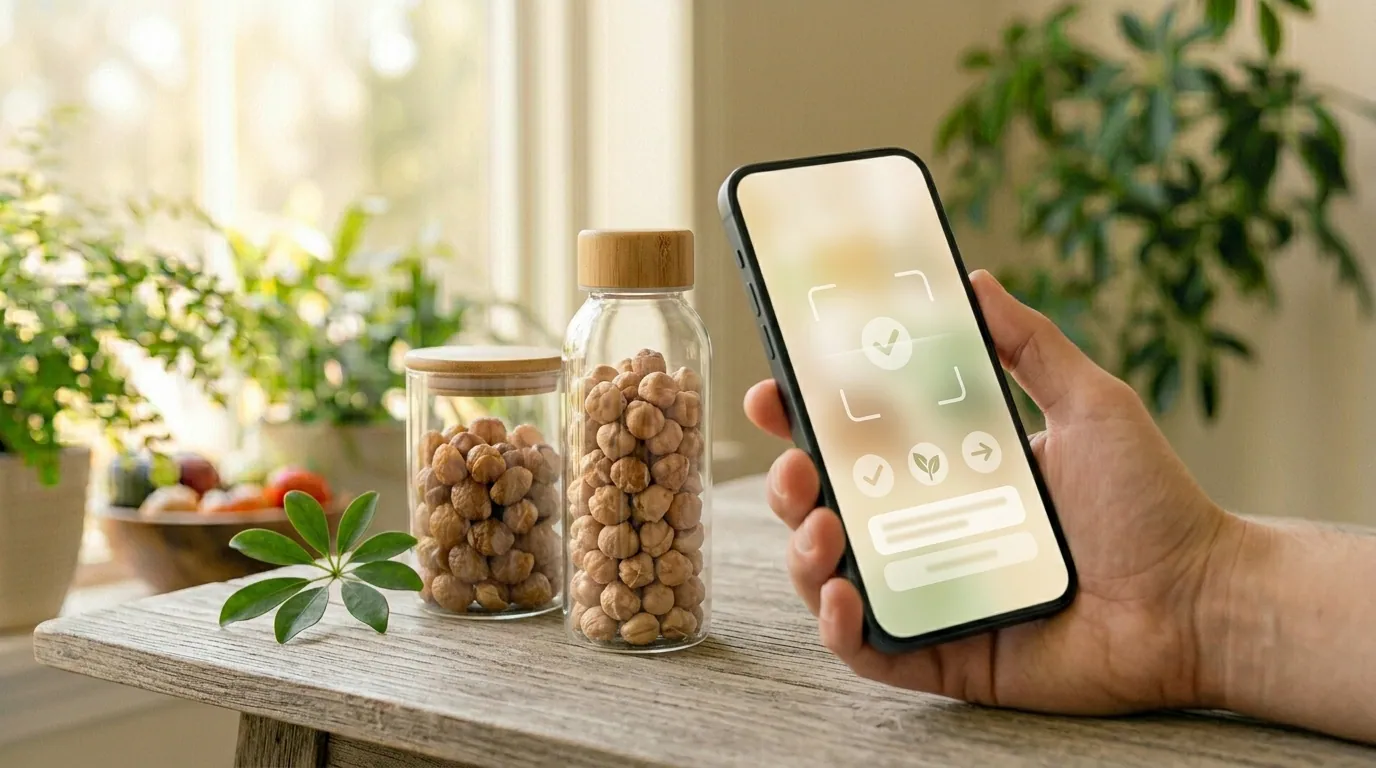
Scan it to see its materials, the evidence behind its score, and a lower-plastic option.


Free · 3 scans · iOS and Android
Key Takeaways
- No consumer at-home test reliably identifies microplastics. Filter kits show particles but cannot confirm they are plastic.
- Lab testing costs $200–$2,000 per sample and uses Raman, FTIR, SEM-EDS, or pyrolysis-GC/MS instrumentation. Worth it for specific suspicions, not for general curiosity.
- Practical at-home approaches: identify high-risk plastic uses (heat, acidity, mechanical wear), swap them out, and read recycling numbers and ingredient lists.
- A polymer-database barcode scanner app gives you most of the actionable information lab testing would give you, for free, instantly.
- For tap water specifically, your local water-utility annual Consumer Confidence Report and the EPA water-quality database give better data than any home test would.
Why no real home microplastic test exists (yet)
Detecting a microplastic is not the same as detecting a particle. Particles in water or on a filter could be:
- Plastic (polyethylene, polypropylene, PET, polystyrene, PVC, nylon, etc).
- Mineral (sand, silica, calcium carbonate from hard water).
- Cellulose fibre (cotton, paper, natural textile lint).
- Biological (algae, biofilm fragments, pollen).
- Metal oxide (iron oxide from old pipes, copper from plumbing).
Telling these apart visually under a regular microscope is unreliable. Confirming a particle is polymer requires identifying its chemical fingerprint, and that needs one of three lab instruments:
- FTIR (Fourier Transform Infrared Spectroscopy). Measures how a particle absorbs infrared light at different wavelengths. Reliable for particles above ~10–20 µm. Lab equipment cost: $30,000–$80,000.
- Raman spectroscopy. Measures inelastic light scattering to get a polymer fingerprint. Reliable down to ~1 µm. Lab equipment cost: $50,000–$150,000.
- Pyrolysis-GC/MS. Heats the sample and analyses the gas products. Can quantify mass of each polymer type even for nanoplastics. Lab equipment cost: $150,000–$300,000.
Until a chip-scale Raman or a smartphone-FTIR exists at consumer price (this is being researched, not yet shipping), there is no device you can buy that confirms a particle is plastic in your kitchen.
The DIY tests you'll see online, and why they don't work
Three formats show up most often in “home microplastic test” search results. Each has a use, none of them confirms microplastics.
- Filter-and-microscope kits. You filter your water through a fine mesh and view the residue under a USB microscope. You will see fibres and particles. You cannot tell what they are made of.
- Nile red staining. A fluorescent dye that binds hydrophobic surfaces, including plastics. Used in research labs as a screening tool. Also stains lipids, biological membranes, and many natural particles, false-positive rate is high in real-world samples.
- Mail-in testing services. Some of these do run real Raman or FTIR on the sample, in which case they are useful but expensive. Others just filter and photograph; check what method is actually used before paying.
If a test costs under $50 and ships back a generic PDF report without naming the analytical method, it is not a real microplastic test.
Lab testing options and what they cost
| Option | Typical cost | Analytical method | Best for |
|---|---|---|---|
| Independent water-quality lab | $200–$500 per sample | Filter + FTIR or Raman | Tap water, well water, baby formula water |
| Research-grade contract lab | $500–$2,000 per sample | Pyrolysis-GC/MS | Suspected contamination, legal evidence, supply-chain audit |
| University collaboration | Variable / sometimes free | Raman, FTIR, SEM-EDS | If you can find a microplastic research group taking citizen-science samples |
| Consumer mail-in “microscope” kits | $30–$80 | Filter + microscopy (no polymer ID) | Limited value, counts particles but does not identify plastic |
| Tap Score / SimpleLab | ~$50–$300 | Various, confirm method before ordering | General tap-water quality, microplastic add-on sometimes available |
What actually works at home, without testing anything
The hard truth is that a $300 lab test of one bottle of water is a worse use of money than spending the same $300 on a high-quality water filter, a few glass storage containers, and a stainless-steel water bottle. The information from a single test is also fragile: the next bottle, the next batch, or the next supply-chain change invalidates it.
The actions that do reduce exposure, without ever testing anything:
- Read recycling numbers and ingredient lists. Recycling #1 (PET) and #5 (PP) are most common in food contact. #3 (PVC) and #6 (PS, polystyrene) are higher-concern. Cosmetics with “polyethylene,” “PEG,” “carbomer,” or “acrylates copolymer” contain plastic.
- Never heat plastic in contact with food. Microwave-safe means the plastic won't melt, not that food won't pick up polymer migrants. Transfer to glass or ceramic before reheating.
- Avoid plastic with acidic foods. Tomato sauce, citrus, vinegar, coffee, yogurt, wine, these accelerate migration. Use glass, stainless, or ceramic.
- Get a known-good water filter. Reverse osmosis (AquaTru, Waterdrop, APEC) is the most reliable for microplastics. NSF/ANSI 401 carbon block filters are a step below. Brita and PUR pitchers are not optimised for microplastic removal.
- Replace high-shed kitchen items first. Plastic cutting boards, black plastic utensils, nonstick PTFE pans with scratches, plastic kettles. Glass / ceramic / stainless / wood replacements.
- Use a polymer-database scanner. A barcode-based app (like MicroPlastics) gives you the same polymer information a lab would, instantly, free, per product.
For tap water specifically, there are better sources than testing
If you're asking the question because you want to know your tap water's microplastic level, lab testing your own sample is one of the worst options. Better:
- Your utility's annual Consumer Confidence Report (CCR). US utilities are required to publish this. Lists source water, treatment, and detected contaminants. Doesn't cover microplastics directly but tells you whether your source is surface or groundwater (surface is consistently higher microplastic).
- EPA's Safe Drinking Water Information System. Searchable database of utility-level water quality.
- Published regional microplastic studies. Multiple US and EU regions have been surveyed in peer-reviewed work. See our regional summary at the link below.
- An NSF-certified reverse osmosis filter. Costs less than three lab tests, removes more than the test would tell you was there.
When you should pay for a real lab test
Lab testing is worth the money in three situations:
- You have specific contamination suspicions. A nearby industrial release, a plumbing renovation, a baby formula source water concern, an apartment with old galvanised pipes.
- You need defensible documentation. Property purchase, legal action, medical workup, insurance claim.
- You're studying a specific product category. A class-action lawyer, a supply-chain audit, a research-curiosity question with budget behind it.
For “is there plastic in my morning coffee”, no, save the money, change the brewing setup. The published research already tells you the answer for nearly every common product.
See also how to check products for microplastics before buying, plastic recycling numbers 1–7 ranked, and best water filter for microplastics.
What the MicroPlastics app checks
- Product polymer composition from the barcode, the same information lab analysis would give you.
- Use-condition risk (cold storage vs heat contact vs acidic food) scored 0–100.
- Ingredient parser for cosmetics, polyethylene, PEG, carbomer, acrylates copolymer, dimethicone flagged automatically.
- The cleaner same-format alternative when one exists in the same product category.
Use the App
Skip the lab test, scan the product instead
A polymer-database scan gives you what a $300 lab test would give you, for everything in your kitchen and bathroom. The MicroPlastics app is free and works on the barcode.
Frequently Asked Questions
Can you test for microplastics at home?
How much does a real microplastic test cost?
Do home microplastic test kits work?
How do I test my tap water for microplastics?
What is the cheapest way to reduce microplastic exposure at home?
Can I see microplastics with a regular microscope?
Are at-home water filter test strips useful for microplastics?
When should I actually pay for lab microplastic testing?
Sources
- Qian N, Gao X, Lang X, et al. (2024). Rapid single-particle chemical imaging of nanoplastics by SRS microscopy. Proceedings of the National Academy of Sciences (PNAS).
- World Health Organization (2022). Dietary and inhalation exposure to nano- and microplastic particles and potential implications for human health. WHO.
- US Environmental Protection Agency (2024). Drinking water requirements: Consumer Confidence Reports (CCR). EPA.
- NSF International (2024). NSF/ANSI 401: Emerging contaminants reduction (including microplastics). NSF.
- Primpke S, Christiansen SH, Cowger W, et al. (2020). Critical assessment of analytical methods for the harmonized and cost-efficient analysis of microplastics. Applied Spectroscopy.
Your next product question
Start with the bottle, container, or appliance you most want to test.
Write down the sample and question you want a test to answer. An app organizes product information; it does not replace validated sampling and laboratory identification.
Use the exact product name, model and label to check the information behind an assessment. A photo does not measure particles or personal health risk. The examples above are research subjects, not a verified app-coverage list.
Read the evidence and model limitations →Go deeper
Less-travelled research from our archive that follows directly from this page.
Related Research
Nanoplastics Size vs Microplastics: How Small Is Nano, Really?
Nanoplastics are below 1 micrometre: small enough to cross cell membranes, the placenta, and the blood-brain barrier. Here is how their size compares to viruses, red blood cells, and human hair.
Read moreHow to Check Products for Microplastics Before You Buy
A 5-second in-aisle check using recycling number + condition + category + brand + heat history. Plus what the MicroPlastics scanner app evaluates and how to use it.
Read moreEU Microplastics Ban 2026: What It Means for Consumers
Regulation (EU) 2026/1168 amended REACH Annex XVII this year, and a 31 May 2026 ECHA reporting deadline has landed. What changed and what it means for shoppers.
Read moreMicroplastics in Pet Food and Bowls: A Dog & Cat Parent’s Guide
Pet food packaging, plastic bowls, and toys all contribute to your pet’s microplastic exposure. Here is what the studies show and the lower-plastic-contact alternatives.
Read moreMicroplastics from Car Tires: The Biggest Ocean Source You’ve Never Heard Of
Tire wear is responsible for 78% of ocean microplastics. A single car releases 1 trillion ultrafine particles per km. Here is what we know.
Read more7-Day Microplastic Detox? An Evidence-Based Exposure Audit
No diet or product can detox microplastics in seven days. Audit water, heating, coffee, storage, cutting boards and tea without turning laboratory counts into a personal exposure score.
Read more