Best Microplastic-Free Products: Our Top Picks for 2026

Quick Answer
Wondering about a product we didn't cover? Scan it and get the same answer in five seconds.
Scan my product
Key Takeaways
- Category winners covered: water filters, water bottles, baby bottles, cookware, food storage, toothpaste, kitchen sponges.
- Common pattern: glass, stainless steel, food-grade silicone, and natural materials (wood, bamboo, cotton, wool) are the lowest-risk choices.
- Use the MicroPlastics app to verify a specific brand before buying, packaging condition matters as much as the brand on the label.
Introduction: Finding Products You Can Trust
Shopping for microplastic-free products can feel overwhelming. Walk into any store and you are surrounded by thousands of items, most of which give you no clear indication of whether they contain synthetic polymers, plastic-derived ingredients, or packaging that leaches microplastics into the product inside. Labels are confusing, marketing claims are often misleading, and the sheer number of choices can lead to decision paralysis.
We created this guide to cut through the noise. After scanning and analyzing thousands of products across every major consumer category using the MicroPlastics app, we have identified the types of products and formulation approaches that consistently score the highest for microplastic safety. Rather than recommending specific brands, which can change their formulations without notice and raise legal concerns, we focus on the product characteristics, ingredient philosophies, and material choices that reliably deliver microplastic-free results. This way, you can apply these principles to any product you encounter, anywhere you shop.
If you are new to checking products for microplastics, we recommend reading our guide on how to check products for microplastics first. It covers the four main methods for evaluating any product, including how to use the MicroPlastics app for instant barcode scanning. For a reference list of the most common microplastic ingredients to avoid, see our breakdown of the worst microplastic ingredients found in everyday products.
How We Tested: Our Scanning Methodology
Our recommendations are based on extensive product scanning and analysis using the MicroPlastics app. Here is how we evaluated products across every category in this guide:
- Barcode scanning at scale. We scanned over 3,000 products across all categories using the MicroPlastics app's barcode scanner. Each product received an instant AI-powered safety score from A (safest) to F (highest concern) based on its ingredient list, packaging materials, and known contamination data.
- Ingredient-level analysis. For every product, we reviewed the detailed ingredient breakdown provided by the app. Products were flagged for any of the known microplastic ingredients, including polyethylene, polypropylene, nylon, acrylates copolymer, carbomer, and dozens of other synthetic polymers. Only products scoring A or B made our recommendation list.
- Packaging evaluation. A product with clean ingredients can still expose you to microplastics through its packaging. We evaluated container materials, liner coatings, and closure systems. Products packaged in glass, metal, or certified compostable materials scored higher than those in plastic containers.
- Consistency checks. We rescanned top-performing products at different times to confirm that formulations remained stable. Products with recent formulation changes were noted, and only those with consistent clean results over multiple checks were included.
- Category benchmarking. Within each product category, we compared the top performers against the category average to identify which approaches and formulation types consistently outperform the rest.
This methodology allowed us to identify not just individual products, but the patterns and characteristics that make a product genuinely microplastic-free. Those patterns are what we share in the recommendations below.
Skincare: Cleansers, Moisturizers, and Sunscreens
Skincare is one of the highest-risk categories for microplastic exposure because these products are applied directly to your skin, often multiple times per day, and many formulations rely on synthetic polymers for texture, spreadability, and film-forming properties. The good news is that excellent alternatives exist in every skincare subcategory.
Cleansers
Many conventional facial and body cleansers contain polyethylene microbeads for exfoliation or acrylates copolymer as a thickening agent. Here are the approaches that consistently score A on our scans:
- Oil-based cleansers with natural emulsifiers. Cleansing oils made from jojoba, sunflower, or coconut oil that use naturally derived emulsifiers like polyglyceryl esters dissolve makeup and impurities without any synthetic polymers. These consistently score A because their ingredient lists are short, recognizable, and entirely plant-derived. Look for formulations where every ingredient comes from a botanical source.
- Traditional cold-process bar soaps. Handcrafted bar soaps made through cold saponification of plant oils (olive, coconut, shea butter) are inherently microplastic-free. The saponification process itself creates a gentle cleanser without the need for any synthetic additives. Bar soaps also eliminate plastic packaging entirely when sold wrapped in paper or cardboard.
- Micellar waters with minimal ingredients. The simplest micellar water formulations use just purified water and gentle plant-derived surfactants to create micelles that lift dirt and oil. Avoid micellar waters with long ingredient lists or those containing fragrance, as the "fragrance" catch-all term can hide synthetic polymer carriers.
Moisturizers
Moisturizers are among the sneakiest products for hidden microplastics. Synthetic polymers like dimethicone crosspolymer, acrylates copolymer, and carbomer are frequently used to create that smooth, silky texture consumers expect. These approaches avoid those pitfalls:
- Pure plant oil and butter blends. Moisturizers formulated entirely from cold-pressed plant oils (argan, rosehip, marula) and unrefined butters (shea, cocoa, mango) deliver exceptional hydration with zero synthetic polymers. These products rely on the natural fatty acid profiles of their ingredients rather than synthetic film-formers to lock in moisture. They score A across the board because there are simply no polymers in the formulation.
- Water-based creams thickened with natural gums. Some effective moisturizers use xanthan gum, guar gum, or cellulose-based thickeners instead of carbomer or acrylates. These natural thickening agents create a pleasant cream texture without any microplastic ingredients. Look for products that explicitly list their thickening system as plant-derived.
- Tallow-based or beeswax-based balms. A growing category of moisturizers uses traditional ingredients like grass-fed tallow, beeswax, or lanolin as their base. These formulations date back centuries and are inherently free of synthetic polymers. They tend to have the shortest ingredient lists of any moisturizer type, which makes them easy to verify as microplastic-free.
Sunscreens
Sunscreen is one of the most difficult categories to find completely microplastic-free, because many UV filters and the formulations that stabilize them rely on synthetic polymers. However, these approaches consistently perform well:
- Mineral-only sunscreens with zinc oxide or titanium dioxide. Mineral sunscreens that use non-nano zinc oxide or titanium dioxide as their active ingredient, suspended in a base of plant oils and natural waxes, avoid the synthetic polymer stabilizers required by chemical sunscreen formulations. The best performers use beeswax or carnauba wax to create water resistance rather than acrylates copolymer films.
- Zinc oxide stick sunscreens. Solid stick formulations tend to have simpler ingredient lists than lotions because they do not require emulsifiers or aqueous-phase thickeners. A zinc oxide stick with a base of coconut oil, beeswax, and shea butter can provide excellent sun protection with an ingredient list you can count on one hand.
Makeup: Foundation, Mascara, and Lip Products
Cosmetics represent one of the categories most heavily contaminated with intentionally added microplastics. Studies have found that up to 87 percent of popular cosmetic products contain at least one synthetic polymer ingredient. Finding truly microplastic-free makeup requires looking beyond mainstream formulations toward specific ingredient philosophies.
Foundation
- Mineral powder foundations. Loose or pressed mineral foundations made primarily from mica, zinc oxide, titanium dioxide, and iron oxides are among the cleanest makeup products you can find. Because they are dry powders rather than liquid emulsions, they do not require the synthetic polymer emulsifiers, film-formers, and thickeners that liquid foundations depend on. The best mineral foundations use naturally derived binding agents like magnesium stearate or rice powder rather than nylon-12 or polyethylene.
- Serum foundations with plant-based carriers. A newer category of liquid foundations uses lightweight plant oils (squalane from olive, jojoba oil) as the carrier instead of silicone or polymer-based vehicles. These formulations deliver buildable coverage while maintaining a clean ingredient profile. Verify that the product does not use dimethicone or cyclomethicone, which are silicone-based polymers commonly found even in otherwise "clean" formulations.
Mascara
- Beeswax and plant-wax based mascaras. Traditional mascara formulations built on beeswax, carnauba wax, and candelilla wax can deliver volume and length without synthetic polymer fibers. These waxes provide the adhesion and flexibility needed to coat lashes while being fully biodegradable. The key ingredient to avoid is nylon-12, which many conventional mascaras use for fiber extension effects.
- Mineral pigment mascaras with natural thickeners. Some clean beauty mascaras use iron oxide pigments suspended in a base of plant-derived thickeners like cellulose and natural gums. These achieve good color payoff without relying on acrylates copolymer or polyurethane for film formation. Look for products certified by COSMOS or NATRUE, as these certification bodies prohibit synthetic polymers.
Lip Products
- Plant oil and wax lip balms. The simplest lip balms, made from just a few ingredients like beeswax, coconut oil, shea butter, and vitamin E, consistently score A in our scans. Because lip products are partially ingested through normal use, choosing microplastic-free formulations here is especially important. Avoid any lip balm or lipstick containing polybutene, polyethylene, or petroleum-derived synthetic waxes.
- Mineral-pigmented lipsticks in metal tubes. Lipsticks that use mineral pigments (iron oxides, mica) in a base of natural waxes and oils can deliver rich color without the synthetic polymers found in most conventional lipsticks. Bonus points if the product comes in a refillable metal tube rather than a plastic case, eliminating packaging-related microplastic contamination as well.
Personal Care: Shampoo, Toothpaste, and Deodorant
Personal care products are used daily by virtually everyone, making them a significant source of cumulative microplastic exposure. The products in this category also tend to be rinsed down the drain, which means any microplastics they contain end up in waterways and eventually in the food chain. Choosing clean formulations here has both personal health and environmental benefits.
Shampoo
- Solid shampoo bars with plant-derived surfactants. Shampoo bars have surged in popularity for good reason. The best formulations use sodium cocoyl isethionate or sodium coco-sulfate derived from coconut oil as the primary cleanser, combined with conditioning butters and essential oils. Because they are solid, they require no plastic bottle packaging, and their concentrated formulations eliminate the need for the synthetic thickeners (like carbomer or polyquaternium) found in liquid shampoos. A single bar typically lasts as long as two or three bottles of liquid shampoo.
- Castile soap-based liquid shampoos. Liquid castile soap, made from saponified plant oils, can serve as an effective shampoo with a formulation that contains zero synthetic polymers. Some people find that adding an apple cider vinegar rinse after washing helps with detangling and shine. When buying castile-based shampoo, choose products packaged in glass or aluminum bottles for the cleanest overall profile.
- Herb-infused rinses and clay washes. A growing number of consumers are switching to rhassoul clay, bentonite clay, or herbal rinse-based hair care. These methods are inherently microplastic-free and have been used across cultures for centuries. While they require a transition period, many users report healthier hair after adjusting.
Toothpaste
- Mineral toothpaste tablets. Toothpaste tablets that you chew and then brush with are one of the cleanest options available. The best formulations use hydroxyapatite (a natural mineral that rebuilds enamel), calcium carbonate for gentle abrasion, and plant-derived surfactants for foaming. They come in glass jars or metal tins, completely eliminating plastic tube packaging. Our scans show these consistently achieving A scores.
- Natural paste formulations in glass jars. If you prefer traditional paste, look for formulations that use baking soda, coconut oil, and essential oils as their base, packaged in glass jars with metal lids. The key ingredients to avoid in toothpaste are polyethylene (used as a polishing agent in some mainstream brands), PEG compounds, and artificial colorants, which can be polymer-based.
Deodorant
- Baking soda and arrowroot-based stick deodorants. Natural deodorants that use baking soda or magnesium hydroxide for odor neutralization, arrowroot or tapioca starch for moisture absorption, and coconut oil or shea butter as the base are consistently microplastic-free. The best options come in cardboard push-up tubes or glass jars, avoiding plastic applicators entirely. These formulations skip the synthetic polymer gelling agents (like steareth-2 or PEG-8 distearate) found in conventional antiperspirants.
- Mineral crystal deodorants. Potassium alum crystal deodorants are single-ingredient products that work by creating a thin mineral layer on the skin that inhibits odor-causing bacteria. They contain zero microplastics, zero synthetic fragrances, and typically last for a year or more. They come as solid crystal sticks or stones, usually with minimal packaging.
Kitchen: Food Storage, Water Bottles, and Cutting Boards
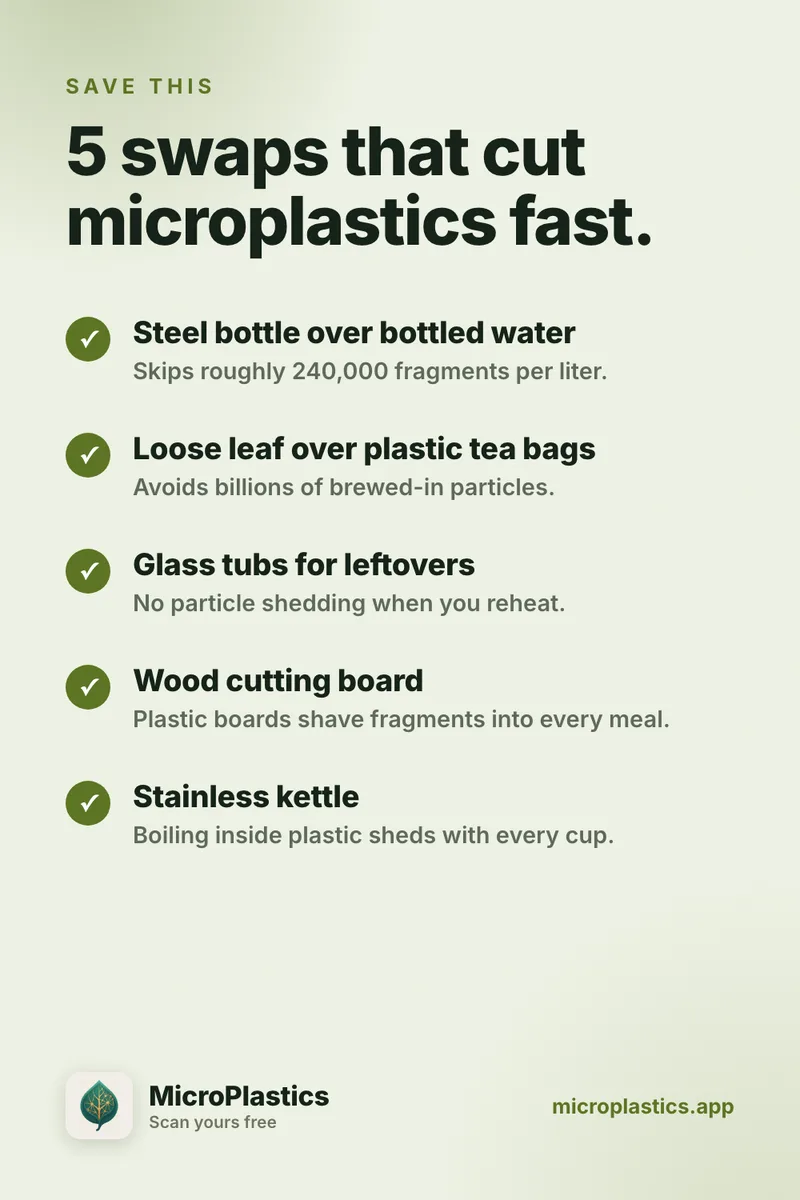
The kitchen is where microplastic exposure meets your food supply directly. Every container, utensil, and surface that touches your food is a potential pathway for microplastic contamination. Research has shown that plastic cutting boards alone can release tens of millions of microplastic particles per year through normal use, and heating food in plastic containers dramatically increases microplastic leaching. Upgrading your kitchen essentials is one of the highest-impact changes you can make.
Food Storage
- Borosilicate glass containers with silicone-sealed lids. Borosilicate glass is stronger and more thermal-shock resistant than regular soda-lime glass, making it safe for freezer-to-oven transitions. Containers with glass bodies and snap-lock lids that use a silicone gasket (rather than a full plastic lid) minimize plastic contact with food. These scored A consistently in our evaluations because the food-contact surface is entirely glass, and medical-grade silicone does not shed microplastic particles.
- Stainless steel containers with silicone lids. For families with children or anyone concerned about breakage, 18/8 stainless steel food containers offer the same microplastic-free food contact with added durability. Look for containers made from food-grade 304 stainless steel, which is non-reactive and does not leach any contaminants. Avoid stainless steel containers with plastic-coated interiors, as some cheaper options use a plastic liner.
- Beeswax wraps and silicone stretch lids. For covering bowls and wrapping leftovers, beeswax-coated cotton wraps are a microplastic-free alternative to plastic cling film. They are washable, reusable for up to a year, and compostable at end of life. Silicone stretch lids that fit over bowls and containers are another reusable option that eliminates single-use plastic wrap from your kitchen.
Water Bottles
- Double-walled stainless steel bottles. Vacuum-insulated stainless steel water bottles keep drinks cold or hot for hours without any plastic touching the liquid. The best options have a stainless steel interior (not painted or coated), a stainless steel or bamboo cap, and a silicone seal. Avoid bottles with plastic straws or flip-top mechanisms, as these put plastic in direct contact with the liquid you drink.
- Glass water bottles with silicone sleeves. For those who prefer to see their water, borosilicate glass bottles with protective silicone sleeves offer complete transparency, both literally and in terms of ingredient safety. Glass is completely inert and will never leach any substance into your water regardless of temperature.
Cutting Boards
- End-grain hardwood cutting boards. Cutting boards made from end-grain hardwood such as maple, walnut, or cherry are the gold standard for microplastic-free food preparation surfaces. End-grain construction is self-healing, meaning knife cuts close up naturally rather than creating grooves where particles accumulate. These boards release only natural wood fibers, which are biodegradable and non-toxic, unlike the polyethylene and polypropylene particles shed by plastic boards.
- Bamboo cutting boards. Bamboo is a rapidly renewable grass that makes excellent cutting boards. It is naturally antimicrobial, harder than most woods, and completely free of synthetic materials. Look for bamboo boards that use food-safe wood glue rather than formaldehyde-based adhesives. Maintain both wood and bamboo boards with food-grade mineral oil or a beeswax and mineral oil blend to keep them in top condition.
Baby Products: Bottles, Toys, and Wipes
Baby products deserve the highest level of scrutiny because infants and toddlers are the most vulnerable to microplastic exposure. Their developing organs, higher intake relative to body weight, and hand-to-mouth behavior all amplify the risk. A 2020 study in Nature Food found that polypropylene baby bottles can release up to 16 million microplastic particles per liter when used to prepare formula at standard temperatures. Choosing the right products for your baby is not just a preference; it is a health priority.
Baby Bottles
- Borosilicate glass bottles with silicone nipples. Glass baby bottles are the single most effective upgrade for reducing infant microplastic exposure. Borosilicate glass releases zero microplastics regardless of temperature, and it can be sterilized without any concern about particle shedding. Pair them with platinum-cured silicone nipples, which are chemically stable and do not degrade under normal use. Silicone sleeves add drop protection for peace of mind.
- Stainless steel baby bottles. For parents who are concerned about glass breakage, medical-grade stainless steel baby bottles are the next best option. They are virtually indestructible, maintain temperature well, and provide a completely microplastic-free feeding experience. Ensure the bottle interior is uncoated stainless steel, not painted or lined with any polymer.
Toys
- Untreated hardwood toys. Solid hardwood toys made from maple, beech, or cherry wood, finished with food-grade plant oils or beeswax, are the safest option for babies who put everything in their mouths. These toys contain no synthetic materials whatsoever and are durable enough to be passed down through generations. Look for toys that are sanded smooth with no small parts, and finished with linseed oil, walnut oil, or beeswax rather than lacquer or paint.
- Natural rubber teethers and toys. Toys made from 100 percent natural tree rubber (harvested from Hevea brasiliensis trees) are soft, flexible, and entirely free of synthetic polymers. Natural rubber is biodegradable and does not shed microplastic particles even when chewed aggressively. Ensure the product specifies "natural rubber" rather than just "rubber," as synthetic rubber is a petroleum-derived polymer.
- Organic cotton stuffed animals. Soft toys made from GOTS-certified organic cotton with natural wool or cotton fill provide a cuddly companion without any synthetic fibers. Unlike polyester stuffed animals, which shed microfibers through normal handling and washing, organic cotton toys release only biodegradable natural fibers.
Wipes
- 100 percent cotton or bamboo viscose wipes. Most conventional baby wipes are made from polyester or polypropylene non-woven fabric, which means every wipe is literally a sheet of plastic being rubbed against your baby's skin. Switch to wipes made from 100 percent cotton or bamboo viscose, which are plastic-free in their substrate. Check the ingredient list of the wetting solution as well, as some otherwise plastic-free wipes use synthetic polymer preservatives.
- Reusable cloth wipes with water. The cleanest option of all is reusable cloth wipes made from organic cotton flannel. Dampen them with plain water or a homemade solution of water and a few drops of almond oil. Wash them with your regular laundry. Over a baby's diaper years, reusable wipes eliminate thousands of disposable plastic-containing wipes from your baby's skin contact and from landfills.
Cleaning Products: Dish Soap, Laundry Detergent, and More
Cleaning products are a category that many people overlook when thinking about microplastic exposure, but they deserve serious attention. The synthetic polymers in cleaning products serve as thickeners, fragrance carriers, optical brighteners, and encapsulation agents. These polymers leave residues on your dishes, clothes, and home surfaces, creating indirect but persistent microplastic contact throughout your day.
Dish Soap
- Plant-based liquid dish soaps with short ingredient lists. The best dish soaps are formulated with plant-derived surfactants like decyl glucoside or coco-glucoside, which are made from coconut and corn sugars. These surfactants clean effectively without any synthetic polymer thickeners or fragrance carriers. Products with five to ten ingredients, all recognizable and plant-sourced, consistently score A in our scans. Avoid dish soaps that list "fragrance" or "parfum," as these catch-all terms often hide synthetic polymer-based fragrance delivery systems.
- Solid dish soap bars and blocks. Like shampoo bars, solid dish soap eliminates the need for both plastic packaging and synthetic thickening agents. A good dish soap block made from saponified coconut and olive oils will last for months, cuts grease effectively, and contains zero synthetic polymers. Simply rub a wet brush or sponge across the block to load it with soap.
Laundry Detergent
- Powder detergents in cardboard boxes. Powdered laundry detergents that use washing soda (sodium carbonate), baking soda, and plant-based soap as their primary cleaning agents are inherently simpler and cleaner than liquid detergents. Liquid detergents often contain polyethylene glycol (PEG) compounds, acrylates copolymer for anti-redeposition, and synthetic fragrance capsules made from melamine-formaldehyde polymer shells. Powder formulations in cardboard packaging avoid all of these.
- Laundry detergent sheets or strips. Pre-measured detergent sheets are a newer product format that dissolves in water. The best formulations use plant-derived surfactants and enzymes on a dissolvable PVA-free substrate. They come in paper envelopes rather than plastic bottles, and their concentrated format means less product per load. Check the ingredient list carefully, as some brands use polyvinyl alcohol (PVA) as the dissolvable substrate, which is a synthetic polymer that may not fully biodegrade in wastewater treatment.
- Soap nuts (soap berries). For the most natural approach possible, dried soap nuts from the Sapindus tree contain natural saponins that create a mild lather when agitated in water. They are effective for lightly soiled loads, completely biodegradable, and contain zero processed ingredients of any kind. They come in cotton or paper bags and can be composted after use.
General Shopping Tips for Microplastic-Free Products
Regardless of category, these principles will help you identify microplastic-free products anywhere you shop:
- Shorter ingredient lists are safer. Products with fewer than ten ingredients are far less likely to contain synthetic polymers than products with thirty or more. Complexity in formulation almost always introduces synthetic additives.
- Look for certifications. COSMOS, NATRUE, USDA Organic, EWG Verified, and the Zero Plastic Inside logo from the Plastic Soup Foundation all indicate products that have been evaluated for synthetic polymer content.
- Avoid the word "fragrance." The single word "fragrance" or "parfum" on an ingredient list can represent dozens of undisclosed chemicals, including synthetic polymer carriers and fixatives. Choose products scented with essential oils or those that list each fragrance component individually.
- Prefer glass, metal, and paper packaging. Even a microplastic-free formulation can pick up contamination from its plastic container over months of shelf time. Glass jars, aluminum tubes, metal tins, and cardboard boxes are the safest packaging options.
- Use the MicroPlastics app at the store. When in doubt, scan the barcode. The app gives you an instant safety score based on the actual ingredient list and packaging data, saving you from having to decode chemical names on the spot. Over time, you will build a mental library of trusted products and know exactly what to reach for.
Conclusion: Building a Microplastic-Free Routine
Transitioning to microplastic-free products does not have to happen overnight. The most sustainable approach is to replace products as they run out, starting with the categories where exposure is highest: skincare, baby products, kitchen essentials, and daily personal care items. Each swap you make reduces your cumulative microplastic intake and sends a market signal to manufacturers that consumers demand cleaner formulations.
The products and approaches outlined in this guide represent what we have found to be the most reliable paths to microplastic-free living across every major consumer category. Remember that no single product exists in isolation. Your total exposure is the sum of every product you use, every container your food touches, and every surface your skin contacts throughout the day. By systematically choosing cleaner alternatives across all categories, the cumulative benefit is far greater than any single product swap.
The MicroPlastics app makes this process practical and manageable. Scan products as you shop, track your exposure over time, and watch your overall safety scores improve as you build a microplastic-free routine. For deeper dives into the specific ingredients to watch out for, explore our guide on the worst microplastic ingredients hiding in everyday products. And if you want a step-by-step walkthrough of how to evaluate any product, our product checking guide has you covered.
Download the MicroPlastics app today and start scanning for a cleaner, safer life.
What the MicroPlastics app checks
- Product packaging material. PET, HDPE, PP, PS, multi-layer, glass, aluminum.
- Container condition from photo, scratches, dents, fade.
- Brand and product category, different SKUs in the same brand can score differently.
- Use-context flags you log, microwave, heat, reuse.
- Cited published research behind each 0–100 score.
Use the App
Get the MicroPlastics app
Scan barcodes + packaging photos. Get a 0–100 microplastic risk score with linked research and safer alternatives. Free to start on iOS.
Get the MicroPlastics appFrequently Asked Questions
What are the best microplastic-free products to start with?
How do you decide which products are truly microplastic-free?
Are "microplastic-free" claims on labels trustworthy?
How often should I replace my microplastic-free products?
Sources
- Qian N, Gao X, Lang X, et al. (2024). Rapid single-particle chemical imaging of nanoplastics by SRS microscopy. PNAS.
- Marfella R, Prattichizzo F, Sardu C, et al. (2024). Microplastics and Nanoplastics in Atheromas and Cardiovascular Events. New England Journal of Medicine.
- Garcia MA, Liu R, Nihart A, et al. (2024). Quantitation and identification of microplastics in human placental specimens. Toxicological Sciences.
- Leslie HA, van Velzen MJM, Brandsma SH, et al. (2022). Discovery and quantification of plastic particle pollution in human blood. Environment International.
- WHO (2022). Dietary and inhalation exposure to nano- and microplastic particles. World Health Organization.
Turn one-time scans into an exposure trend line
The web shows you the research; the app remembers what you scanned and tracks whether your overall microplastic exposure is going down month over month. Free to start with 3 scans on iOS.
Download on the App Store- Free on iOS
- 3 free scans
- No sign-up
- Result in seconds
“Really cool to scan stuff around the kitchen and see what's actually in it. The swaps it suggests are realistic.” App Store review · 5.0★
Android · early access
Get the launch email the day Android opens.
One email. No spam. We send when the Android app is in the Play Store, and never again unless you opt in.
Related Research
Microplastics in Travel: Toiletries, Hotel Water, Plane Food (2026)
Travel toiletries, hotel bottled water, plane food trays, in-room PP coffee makers, sunscreen at the beach: every summer-travel microplastic source in one place. Pack smarter and scan suspicious items with the MicroPlastics app before you check in.
Read morePlastic Scan Apps in 2026: What They Do, How They Work, and Which One to Use
A plastic scan app turns your phone camera into a packaging risk-checker. Here is what these apps actually do, what they can and cannot detect, and how to use one to cut your microplastic exposure.
Read moreHow to Test for Microplastics at Home: Honest 2026 Guide
No reliable at-home microplastic test exists yet: Raman and FTIR equipment cost more than a car. Here is what actually works for spotting and reducing exposure without lab testing.
Read moreNanoplastics Size vs Microplastics: How Small Is Nano, Really?
Nanoplastics are below 1 micrometre: small enough to cross cell membranes, the placenta, and the blood-brain barrier. Here is how their size compares to viruses, red blood cells, and human hair.
Read moreThe Complete 2026 Microplastics Action Plan: 30-Day Reset
A complete 30-day plan to dramatically reduce your microplastic exposure. Daily actions, weekly priorities, and the full evidence-based reset for 2026.
Read moreHow to Avoid Microplastics: The Complete 2025 Guide
From your kitchen to your closet, microplastics are everywhere. This comprehensive guide covers 50+ practical, evidence-based ways to reduce daily exposure.
Read more