How to Check Products for Microplastics Before You Buy Them

Last reviewed: by the MicroPlastics Research Desk. Submit a correction or see our editorial standards.
Quick Answer
Wondering about a product we didn't cover? Scan it and get the same answer in five seconds.
Scan my product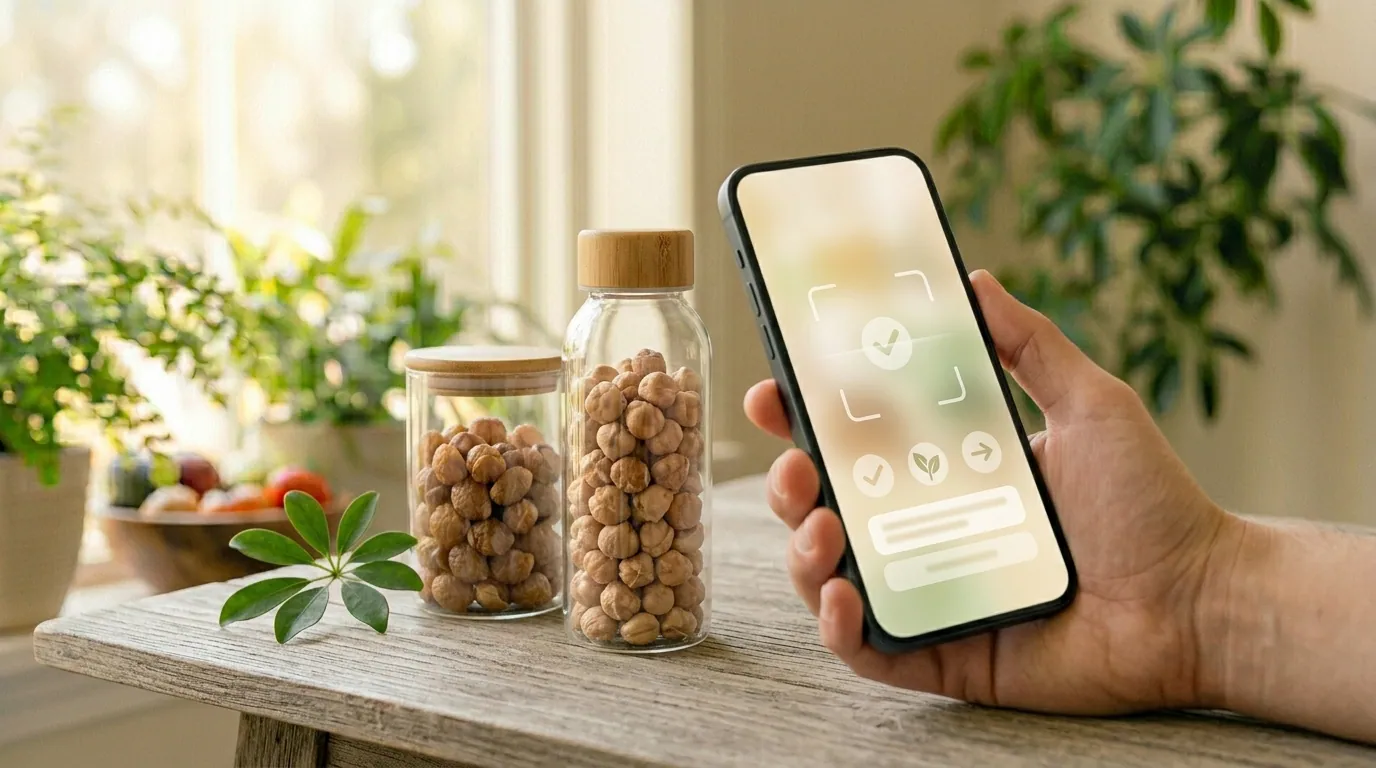
Two products can sit on the same shelf, look almost identical, and have very different microplastic risk. The packaging recycling number, the cap style, how long it's been on shelf, whether the container has obvious scratches or dents, and what the brand is known for all change the score. You can do most of this check in 5 seconds before the product goes in your cart.
| Number | Plastic | Common uses | Microplastic risk |
|---|---|---|---|
| #1 | PET / PETE | Water, soda, oil bottles | Single-use only; sheds with heat, UV, time, reuse |
| #2 | HDPE | Milk jugs, detergent | Lower migration; cap-side wear still adds particles |
| #3 | PVC / V | Cling wrap, blister packs | High: phthalates often added; avoid for food |
| #4 | LDPE | Bread bags, squeeze bottles | Lower migration but sheds with damage |
| #5 | PP | Yogurt cups, takeout, kettles | Lower migration; "microwave-safe" claims do not mean particle-free |
| #6 | PS | Foam cups, takeout clamshells | High: leaches styrene, especially with hot or fatty food |
| #7 | Other (often polycarbonate / BPA) | 5-gallon jugs, baby bottles (old) | Often BPA; assume worst unless verified |
Key Takeaways
- You can do a 5-second in-aisle plastic check using recycling number + condition + category + brand + heat history.
- Avoid #3 PVC, #6 PS, and #7 (often BPA) for food contact.
- Scratches, dents, foggy bottles, and faded labels mean the plastic has been shedding longer.
- Acidic / hot / fatty contents leach more than cold neutral contents.
- Barcode-only apps miss packaging condition and context, a scanner that uses both barcode and photo gives a much more accurate score.
- Glass, aluminum, and stainless are the universal upgrades when they exist for the category.
The 5-second in-aisle check
- Flip the package over. Find the recycling number (a number inside a triangle). #3, #6, and #7 are the ones to put back. #1 PET is okay cold and single-use only. #2, #4, #5 are acceptable for most cold contents. Glass and aluminum are universally safer.
- Look at the container condition. Scratches, dents, foggy plastic, faded labels, deformed shapes, every one of these means the plastic has been shedding for a while. Pick the cleanest item on the shelf.
- Match the package to the contents. Hot? Acidic? Fatty? Carbonated? Each of those speeds up plasticiser migration. Hot soup in a PS clamshell is worse than cold rice in the same clamshell.
- Check the brand. Some brands disclose packaging material, some carry certifications (BPA-free, NSF, EWG VERIFIED, MADE SAFE). Most don't. Brand familiarity isn't the same as plastic safety.
- Consider the heat and storage history. Hot truck rides, sun-baked store shelves, long warehouse times all push polymer breakdown before you ever pick the product up.
Why barcode-only apps miss half the story
Many food-rating apps just read the barcode and look up ingredients in a database. That tells you the product but not the package, and for microplastics, the package is most of the risk. Two bottles of the same brand water, one stored in a cool dark warehouse and one in a hot sunlit pallet, deliver very different particle loads when you open them.
The MicroPlastics scanner app uses both the barcode and a photo of the actual product on your shelf. The barcode pulls brand, category, and packaging spec from the catalog. The photo lets the scoring model see scratches, dents, fade, condition, and lid style. Together they produce a 0–100 risk score with the cited research available inside each scan.
Category-by-category quick check
| Category | Quick check |
|---|---|
| Bottled water | PET (#1) single-use only; glass / aluminum better; avoid dented bottles or hot-stored cases |
| Tea bags | Paper-only certified; avoid pyramid mesh; loose leaf wins |
| Coffee | Whole bean in foil; avoid plastic K-cups; stainless travel mug instead of paper-lined cup |
| Canned food | Glass-jarred preferred; for cans, look for "BPA-free" + non-acidic contents |
| Yogurt | Glass-jarred is best; PP (#5) cups are acceptable; avoid PS |
| Baby food | Glass-jarred or homemade; avoid pouches with multi-layer plastic |
| Cosmetics | Scan ingredients for polyethylene, acrylates copolymer, PEG, carbomer, dimethicone, "fragrance" |
| Cookware | Avoid non-stick PTFE; pick stainless, cast iron, ceramic-coated, enameled cast iron |
| Food storage | Glass (Pyrex, Anchor); silicone for travel; stainless for kids |
| Cutting boards | Wood or bamboo for raw produce; not plastic |
What you can't check manually
- Hidden additives. Plasticisers (phthalates) and stabilizers aren't on most food labels.
- True heat history. The label won't tell you the case sat on a hot pallet for 6 weeks.
- Liner chemistry inside cans. “BPA-free” sometimes means BPS, which has similar concerns.
- Cap and seal materials. Often unlabeled despite being a major shedding source.
- Cumulative score across the product's lifecycle. This is what a scanner with research backing handles for you.
What the MicroPlastics app checks
- Barcode lookup, brand, product category, declared packaging.
- Photo of the actual item, scratches, dents, label condition, lid style.
- Material weighting. PET, HDPE, PP, PS, PVC, multi-layer, glass, aluminum.
- Use-context flags you log, heated, reused, acidic contents, age.
- Published study references inside each scan, with the polymer-specific findings cited.
- Safer alternative suggestions when the score is high.
Use the App
Check before it goes in the cart
Tap the barcode and snap the packaging. The MicroPlastics app weighs material, brand, condition, and category, then gives a 0–100 risk score with the cited research.
Get the MicroPlastics appWhat to do today
- Memorize the avoid list: #3 PVC, #6 PS, #7 (often BPA) for food contact.
- Always flip the package before it goes in the cart.
- Pick the cleanest item on the shelf when buying anything plastic-packaged.
- Bring your own glass or stainless for drinks, leftovers, and bulk bin purchases.
- Scan five items per shopping trip to build your exposure baseline.
Related reading: microplastic-free kitchen swaps, best microplastic-free products, plastic recycling numbers explained, 25 highest-risk foods.
Frequently Asked Questions
How can I tell if a product contains microplastics?
Is there an app that scans products for microplastics?
Which recycling numbers are safest for food?
Does "BPA-free" mean microplastic-free?
How accurate are microplastic scanner apps?
What should I do if the score is high?
Why does container condition matter?
Sources
- Hussain KA, Romanova S, Okur I, et al. (2023). Assessing the Release of Microplastics and Nanoplastics from Plastic Containers and Reusable Food Pouches. Environmental Science & Technology.
- Qian N, Gao X, Lang X, et al. (2024). Rapid single-particle chemical imaging of nanoplastics by SRS microscopy. PNAS.
- European Chemicals Agency (2023). Restriction on intentionally added microplastics. ECHA.
- US FDA (2024). Bisphenol A (BPA): Use in Food Contact Application. FDA.
- Environmental Working Group (2024). EWG's Food Scores & Skin Deep Databases. EWG.
Turn one-time scans into an exposure trend line
The web shows you the research; the app remembers what you scanned and tracks whether your overall microplastic exposure is going down month over month. Free to start with 3 scans on iOS.
Download on the App Store- Free on iOS
- 3 free scans
- No sign-up
- Result in seconds
“Really cool to scan stuff around the kitchen and see what's actually in it. The swaps it suggests are realistic.” App Store review · 5.0★
Android · early access
Get the launch email the day Android opens.
One email. No spam. We send when the Android app is in the Play Store, and never again unless you opt in.
Related Research
Microplastics in Travel: Toiletries, Hotel Water, Plane Food (2026)
Travel toiletries, hotel bottled water, plane food trays, in-room PP coffee makers, sunscreen at the beach: every summer-travel microplastic source in one place. Pack smarter and scan suspicious items with the MicroPlastics app before you check in.
Read morePlastic Scan Apps in 2026: What They Do, How They Work, and Which One to Use
A plastic scan app turns your phone camera into a packaging risk-checker. Here is what these apps actually do, what they can and cannot detect, and how to use one to cut your microplastic exposure.
Read moreHow to Test for Microplastics at Home: Honest 2026 Guide
No reliable at-home microplastic test exists yet: Raman and FTIR equipment cost more than a car. Here is what actually works for spotting and reducing exposure without lab testing.
Read moreNanoplastics Size vs Microplastics: How Small Is Nano, Really?
Nanoplastics are below 1 micrometre: small enough to cross cell membranes, the placenta, and the blood-brain barrier. Here is how their size compares to viruses, red blood cells, and human hair.
Read moreThe Complete 2026 Microplastics Action Plan: 30-Day Reset
A complete 30-day plan to dramatically reduce your microplastic exposure. Daily actions, weekly priorities, and the full evidence-based reset for 2026.
Read moreBest Microplastic-Free Products: Our Top Picks for 2026
We scanned thousands of products with the MicroPlastics app. Here are the cleanest, safest products across food, cosmetics, and household categories.
Read more